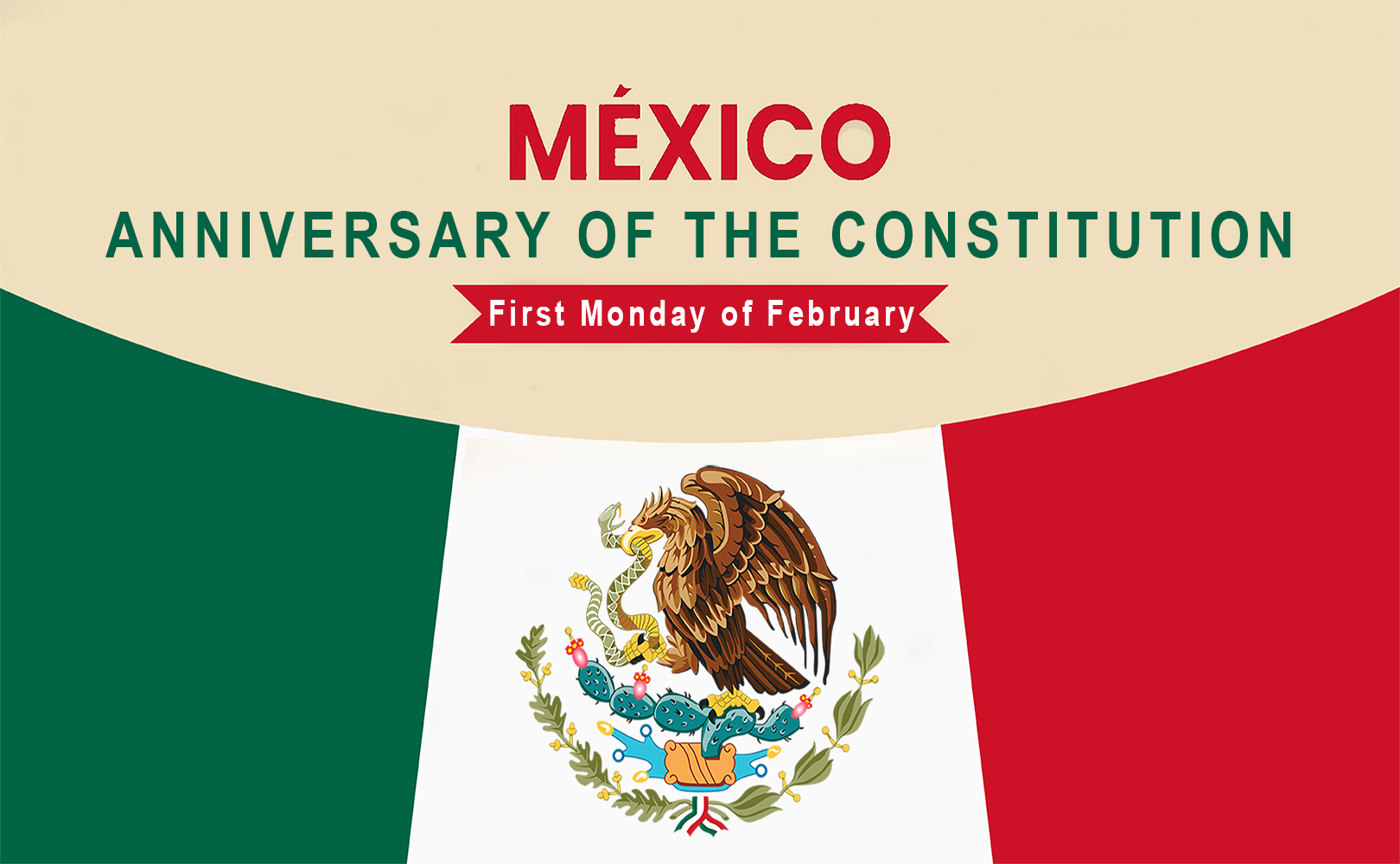
Anniversary of the Constitution (Día de la Constitución) is one of five Public Holidays (Fiestas Patrias) in Mexico. This important national holiday is celebrated annually on the first Monday of February to commemorate the promulgation of the 1917 Constitution. The 1917 Constitution was a direct result of the Mexican Revolution, a decade-long conflict that began in 1910 and sought to address longstanding issues of inequality, land distribution, and workers’ rights. The document itself was drafted by a constitutional congress convened in Querétaro and promulgated on February 5, 1917. It replaced the earlier 1857 Constitution and marked a turning point in Mexican history, ushering in a new era of social and political reforms.
The holiday honors the foundational document that established modern social rights, labor laws, and democracy in Mexico. Among its most significant reforms were land redistribution to benefit peasants and rural communities, the recognition of labor rights, including the right to organize and strike, and the establishment of free, mandatory public education. These reforms laid the groundwork for a more just and equitable society and influenced constitutional reforms worldwide.
Key details regarding this holiday include:
Historical Significance: Promulgated on February 5, 1917, in Querétaro, the document was the result of the 1910 Revolution, aimed at overthrowing the dictatorship of Porfirio Díaz and enshrining social reforms, including land reform and worker rights.
Progressive Foundation: The 1917 Constitution is recognized as one of the first in the world to include broad social rights. When it was promulgated, it was revolutionary for its time, adopting principles that were not common in other constitutions worldwide. Unlike many constitutions that focused primarily on political rights, the Mexican Constitution of 1917 included comprehensive social rights, including labor laws, land reform, and education. These provisions influenced future constitutional reforms worldwide, setting a precedent for recognizing the government’s role in ensuring social justice and economic equity.
Date Observance: While the original document was signed on February 5, the holiday is observed on the first Monday of February to create a long weekend for residents, a practice enacted in 2006.
Celebration: As a Fiesta Patria (national holiday), it is marked with government ceremonies, parades, and educational events, though it is often more subdued than other holidays. Today, celebrations vary across regions, with some communities organizing local cultural events, musical performances, and traditional dances. In urban areas, civic speeches and educational activities are held to enhance public understanding of the Constitution’s historical significance. In more rural settings, festivities may include community gatherings that emphasize regional traditions.
The Five Public Holidays
1. Aniversario de la Constitución – First Monday of February
The Aniversario de la Constitución (English: “Anniversary of the Constitution”) commemorates the Constitution of 1917, promulgated on February 5 after the Mexican Revolution. Article 74 of the Mexican federal labor law (Ley Federal del Trabajo) provides that the first Monday of February (regardless of the date) will be an official holiday in Mexico. This was a 2005 law modification, effective in 2006; before then, it was celebrated on February 5 regardless of the day of the week.
2. Natalicio de Benito Juárez – Third Monday of March
Natalicio de Benito Juárez (English: Birth of Benito Juárez) commemorates the birthday of President Benito Juárez on March 21, 1806. Juárez is widely regarded as Mexico’s most respected president, known for instituting the separation of Church and State during La Reforma (Liberal Reform in Mexico). He is recognized across the Americas for his role in resisting European recolonization. Article 74 of the Mexican labor law (Ley Federal del Trabajo) establishes the third Monday of March as an official holiday in Mexico. Like Constitution Day, the holiday was originally observed on March 21, but, following a 2005 amendment, it is now always celebrated on a Monday.
3. Día del Trabajo – May 1
Día del Trabajo (English: Labor Day) honors the Mexican workers’ union movements on May 1, notably the 1906 events in Cananea, Sonora, and the 1907 unrest in Río Blanco, Veracruz. Labor Day in Mexico traces its origins to the 1886 Haymarket massacre in Chicago. The first Labor Day in Mexico was in 1913, when 20,000 workers marched against President Victoriano Huerta to demand fair working conditions. In 1923, President Álvaro Obregón declared May 1 as Día del Trabajo en México, and the day was officially established by Plutarco Elías Calles in 1925.
4. Grito de Dolores and Aniversario de la Independencia – Evening of September 15 and Day of September 16
Grito de Dolores (English: Cry of Dolores) (on the evening of September 15) and Independence Day (Aniversario de la Independencia) (September 16) commemorate Father Miguel Hidalgo y Costilla’s Grito de Dolores — on September 16, 1810, in the village of Dolores, near Guanajuato. Hidalgo called for the end of Spanish rule in Mexico. On October 18, 1825, the Republic of Mexico officially declared September 16 its national Independence Day (Día de la Independencia).
Mexican Independence Day, also referred to as Dieciséis de septiembre, is celebrated from the evening of September 15 with a re-creation of the Grito de Dolores by all executive office-holders (from the President of the Republic down to municipal presidents) and lasts through the night.
5. Aniversario de la Revolución – November
Aniversario de la Revolución (English: Revolution Day) commemorates the Mexican Revolution, which started on November 20, 1910, when Francisco I. Madero planned an uprising against the 31-year iron rule of dictator Porfirio Díaz. Article 74 of the Mexican labor law (Ley Federal del Trabajo) provides that the third Monday of November (regardless of the date) will be an official holiday in Mexico. This was a 2005 law, effective in 2006; before then, it was November 20 regardless of the day, and all schools gave extended holidays if the day was a Tuesday or Thursday. Although November 20 is the official day, the uprising started on different days in different parts of the country.
Confusion regarding Cinco de Mayo
Contrary to common misconception in the U.S., Cinco de Mayo is not Mexico’s “Independence Day.” Instead, it commemorates the victory of Mexican Republican forces over the French at the first Battle of Puebla on May 5, 1862. This date is significant because it marked a successful defense against a much larger foreign army, symbolizing Mexican resilience and unity. Although the French later won subsequent battles in Puebla, the initial victory provided a morale boost and became an enduring symbol of resistance and national pride within Mexico.
Together, Mexico’s Fiestas Patrias and commemorations such as Constitution Day and Cinco de Mayo reflect a collective commitment to honoring milestones that have shaped the nation’s identity, driving progress, unity, and the ongoing pursuit of social justice for all its citizens.