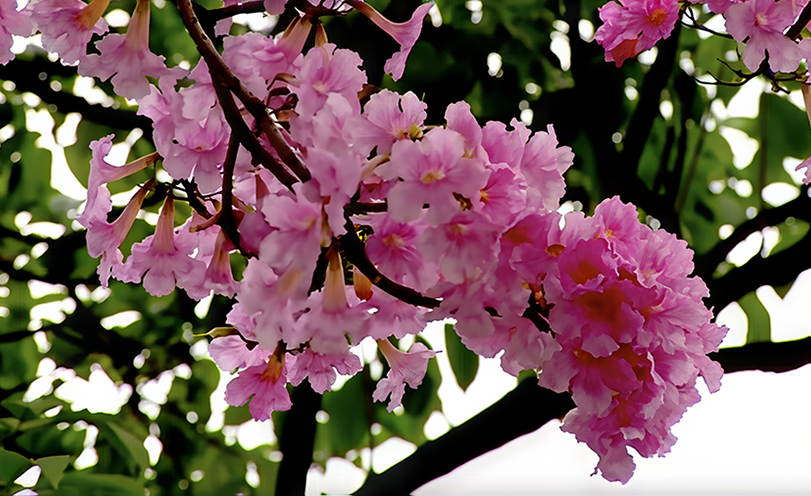
The pink flowering trees compete in beauty with the jacarandas of Cuernavaca. The Maculís Rosado [stained rose] in Spanish is known in English as the Rosy Trumpet Tree. Its beauty lies in its spectacular, vibrant pink flowers that appear before the tree regains its leaves, blanketing city streets, gardens, or natural landscapes in a breathtaking display of color. These deciduous trees are admired for their seasonal blooms, which signal the arrival of warmer weather and provide a stunning spectacle that draws widespread public interest and visual appeal.
The most striking aspect of the maculísm rosado is its abundant, bright pink flowers, which are similar to those of the jacaranda. The flowers create a beautiful, colorful scene, especially when they fall.
Tabebuia Rosea
The maculísm rosado is botanically known as Tabebuia Rosea, which comprises sixty-seven species and is a genus of flowering plants in the family Bignoniaceae. Tabebuia consists almost entirely of trees, but a few are large shrubs. The trees live approximately 50 years.
The Tabebuia species include flowers in various colors, yellow, pink, purple, and white, with subtle variations and gradations in between. Different species within the genus display these distinct colors, with some trees blooming in shades of golden yellow, while others are known for their magenta, pink, purple, or white trumpet-shaped flowers, often tinged with yellow throats.
Many species have twigs with soft pith, which forms hollows within which ants live, defending the trees from other herbivores. The ants are attracted to the plants by special extra-floral nectar glands at the apex of the petioles. In fact, the name Tabebuia entered the botanical literature in 1803, when António Bernardino Gomes used it as a common name for Tabebuia uliginosa. Which he described as a Tabebuia, is an abbreviation of “tacyba bebuya”, a Tupi name meaning “ant wood”.
Distribution and Habitat
Members of the Tabebuia species can be found throughout the tropical regions of the southern American continent, from Southern Mexico to Peru. It has been found growing from sea level to 1,200 m (3,900 ft), in temperatures ranging from 20°C to 30°C (68°F to 86°F) on average, with annual rainfall above 500mm (19.685 in), and on soils with variable pH.
The maculísm rosado is a deciduous tree, meaning it loses its leaves during the dry season to conserve water and energy, prioritizing the development of its flowers. As a result, flowering varies between different climates. The early flowering of maculísm rosado is a phenomenon that has generated interest because it suggests the trees are reacting to changes in temperature and rainfall, providing a visual indication of climate shifts.
This tree is often seen in Neotropical cities, where it is frequently planted in parks and gardens.
Size
The maculis rosado typically reaches a height of between 6 and 10 meters (20 to 30ft), although in optimal conditions, it can reach 25 meters (82ft). It has a short, brown-barked trunk. Their foliage consists of palm-like leaves with 3 to 5 folioles. Its inflorescence arises from particular bouquets. The flowers can have a pink, lavender, or magenta bell-shaped body, with tinges of yellow.
Fruit
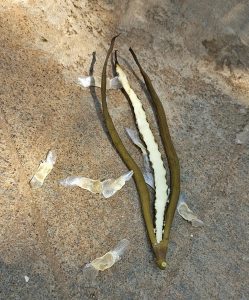
Its fruit is a 25cm (10in) cylindrical capsule with 7 to 10 white winged seeds. The seeds’ wings provide a natural ability to spread via wind, which is a key survival mechanism. Those white-winged seeds resemble thin butterfly wings, and their wings help to spread the propagation of the trees far and wide.
Uses
The high-quality hardwood of this species is similar to oak and is used in the manufacture of musical instruments, fuel, firewood, charcoal, rural construction, agricultural implements, and tool handles. This wood is of excellent quality and is also used to make furniture and cabinets, posts, interior decoration, oars, plywood veneer, lamella, plywood, parquet, firearm stocks, and cabinetmaking. Due to the quality of its wood, it was heavily exploited, so its usage is limited.
Medicinal Uses
Chemically, this tree is rich in naphthalene, which is linked to vitamin K. Preparations from the bark of the tree are being studied as a potential treatment for uterine cancer. A decoction of the bark has been used to treat anemia, constipation, control diabetes, kill parasites, and treat typhoid. A decoction of the flowers, leaves, and roots has been used to reduce fevers and pain, cause sweating, treat tonsillitis, and various other disorders. It is recommended that you consult a doctor before using any products from the tree.