 Colonel William (Bill) H. Donaldson (May 1864–August 1, 1925) – Donaldson founded The Billboard Advertiser (now Billboard Magazine). If you are wondering how the founder of Billboard Magazine is associated with screenprinting, we will get there in a moment. However, if not for Donaldson and his ventures, we might not have the International Sign Association (ISA) and the Specialty Graphics and Imaging Association (SGIA), Screen Printing Magazine, The Swormstedt Awards, and Printing United Alliance, to name just a few.
Donaldson was born in Dayton, Kentucky, to William M. Donaldson (1840–1931) and Jennie Porter Donaldson (1837–1872). Donaldson had half-siblings; James Garfield Donaldson (unknown–1883), Jennie Lindsey Clark (1859–1928), John Fleming Donaldson (1880–1881), and Lincoln Donaldson (1884–1932).
Donaldson Lithographing Co.
 Donaldson’s father, William M. Donaldson, originally owned an art store and picture-framing establishment in Cincinnati, Ohio. In 1863, before Donaldson was born, his father founded The Donaldson Lithographing Company in Cincinnati. The company specialized in circus and theatrical posters, some printed using the newly developed screenprinting process. In 1898, the company moved across the Ohio River to Newport, Kentucky, and later expanded to New York and London.
Ownership of the Donaldson Lithographing Company remained in the Donaldson family until 1981. Unfortunately, the company declared bankruptcy in 1987.
After attending high school, Donaldson began working for his father as a salesman and proved to be a remarkably capable, winning, and acknowledged place as the best poster salesman in the country. Donaldson rose to nationwide prominence as a circus and theatrical publisher.
In 1885, Donaldson married Jennie Hasson (1864-1949), and they had a daughter Marjorie Donaldson (b. 1888), who married Roger Seiter Littleford (1887-1959) on September 17, 1910, of Fort Thomas, Kentucky. Roger and Marjorie had two sons, Roger Seiter Littleford, Jr. (1911-1987), and William Donaldson Littleford (1914-2009), who would become the joint publishers of Billboard Magazine. They had two daughters; Jane Littleford (1913-unknown), and Marjorie S. Littleford Ross 1924-2017).
Donaldson was a Masonic Order and Odd Fellows member, to which he devoted much attention. He was interested in prison reform, employed many former convicts upon their release, and declared that any never defrauded him of them.
Donaldson was a community leader serving as Chairman of the Board of Trustees for the District of Fort Thomas, Campbell County, Kentucky in 1906-1906, and again in 1914, before it became the city of Fort Thomas.
Billboard Magazine
Donaldson also owned a billboard posting service with a partner James F. Hennegan (1835-1899). The company was founded to serve their family firms’ far-flung customers hawking the claims of patent medicines and announcing that the circus was coming to town.
According to a history written by Roger Seiter Littleford, Jr., the founders of Billboard, William H. “Bill” Donaldson and Roger Seiter Littleford, built the magazine to serve an entirely different need. Donaldson worked for the family business, a Newport, Kentucky-based lithography shop that churned out advertisements and posters for the circuses, fairs, and other traveling shows crisscrossed the country. Donaldson realized that most of his clients—the managers and owners who ordered the posters, especially the billstickers tasked with staying one step ahead of the shows and pasting the posters to every available surface—lacked permanent addresses and thus were unable to communicate with each other.
In 1894, Donaldson started to spend his nights and weekends putting together Billboard Advertising, a trade publication dedicated to gathering all the news that might be relevant to his more itinerant peers. The first issue, published that November, had eight pages of relevant tidbits, laid out in columns like “Bill Room Gossip” and “The Indefatigable And Tireless Industry of the Bill Poster.” Now the “advertisers, poster printers, bill posters, advertising agents, and secretaries of fairs,” as the issue categorized them, could pick up a magazine at a newsstand anywhere in the country and know what to expect on the opposite coast.
Billboard Advertising
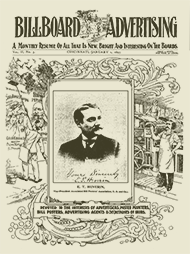
In 1894, Donaldson and Hennegan met and discussed the nickel-in-the-slot phonograph that Louis Glass and William S. Arnold invented in 1890. This device was the forerunner of the modern jukebox, an Edison Class M Electric Phonograph retrofitted with a device patented under Coin Actuated Attachment for Phonograph. The device was well-received in so many establishments that Donaldson and Hennegan saw an opportunity to start a magazine to record artists and their newest works to the owners of the coin-operated phonographs.
Together, Donaldson and Hennegan hatched The Billboard Advertiser. The first issue came out on Nov. 1, 1894.
 The magazine became an instant hit and grew rapidly across the USA and abroad. The first issue of the Billboard was published in November at 127 East Eighth Street, Cincinnati, containing only eight pages, with its contents being solely and entirely to bill-posting, poster-printing, and advertising agency interests. Running eight pages, the publication cost only 10 cents, and a one-year subscription cost 90 cents.
Hennegan passed away in 1899, at age 64, in Missouri.
In 1899, the Donaldson plant moved to Newport, Kentucky. Donaldson remained with the business until 1904, when he resigned to devote his entire time to Billboard. He was the president of the Billboard Publishing Company.
Today, the magazine has changed its name to Billboard. A one-year subscription will set you back $299.88. Back issues sell for $8.99
The Donaldson Guide
Also, in 1894, Donaldson founded and published The Donaldson Guide, which included Showman’s Encyclopedia. That same year, he was appointed Secretary of the Protective League of American Showman (The Cincinnati Enquirer, 31 Dec. 1894, page 8).
The Donaldson Guide was published “for the use of showmen, theatrical managers, circus managers, managers of opera-houses, dramatic, musical, as well as various agents, bill posters, show printers, costumers, and all Persons identified or connected with the show business in any manner whatever.”
The publication was advertised as “containing a list of all opera houses in the United States and Canada with a description of their stages, their seating capacity, and the names of the managers of each; the populations of cities, and the names and population of adjacent towns to draw from; the names of city bill-posters, baggage expressmen, hotels, boarding-houses, newspapers, vaudeville resorts, museum, beer gardens, fairs, race meetings, circus licenses, and miscellaneous facts, dates, etc., of great value to managers.” Donaldson Guide also noted that it was published “in conjunction with the Showman’s Encyclopedia, “the International Professional Register,” and “the complete code of the Donaldson cipher.”
The Donaldson Guide included a Showman’s Encyclopedia in 1894. The Showman’s Encyclopedia was noted as “A compilation of information for showmen, performers, agents, and everyone identified with the theatrical, vaudeville, or circus business, such as ticket tables, internet tables, the address of show-painters, costumes, dramatic agents, theatrical architects, scenic artists, aeronauts, playwrights, etc.” and “the International Professional Register, a directory of the names and address of dramatic people, variety people, minstrel people, circus people, freaks, acrobats, operatic artists, musicians, and farce-comedy artists.
Signs of the Times
 In 1906, W.H. Donaldson ventured into another magazine for the manufacturers and buyers of signs. It was the Signs of the Times Magazine, which remains a fixture of the signage industry. Initially, the magazine was distributed to 4,650 subscribers in 42 cities in the USA., educating and informing a community of signmakers about the art and business of sign painting, electrical signage, billboards, and outdoor advertising. And, yes, early on, many signmakers used the screenprinting process when they received orders for multiple signs.
The following year in 1907, Donaldson hired H.C. Menefee as an editor, who eventually purchased the magazine in 1914. To expand the editorial content, Menefee hired sign painter Tom Kelley as editor in 1924 to keep up with the technological advancements in signage, including neon lighting, fluorescent tubing, and plastics.
Donaldson Passes
Donaldson passed away on August 1, 1925, at 61 in Sarasota, Sarasota County, Florida. He is buried at the Evergreen Cemetery in Southgate, Campbell County, Kentucky.
The Cincinnati Enquirer reported, “Mr. Donaldson was a member of the Masonic Order and Odd Fellows, to which he devoted much attention” (2 Aug. 1925, page 5). An article in the “Cincinnati Enquirer” reported that “Colonel Donaldson founded the Billboard and published it until two years before his death. He was interested in prison reform, employed many former convicts upon release, and declared that he was never defrauded by any of them” (4 Aug. 1925, page 2).
He was survived by his widow Jennie Hasson Donaldson (1864–1949), whom he married in 1885, a daughter Marjorie (Mrs. Roger S. Littleford), his father, William H., and three brothers (Andrew, Lincoln, and Archibald) and two sisters, (Mrs. Charles Longley and Mrs. Dr. George W. Brown).
Donaldson’s death in Sarasota, Florida, at the relatively young age of 61 shocked his family. Having been in failing health for some time, he came to Sarasota at the suggestion of his friends, Charles and John Ringling (The Jacksonville Daily Journal, 2 Aug. 1925, page 3).
Dave Swormstedt, Sr.
In 1937, David Reid Swormstedt, Sr. became vice-president, working alongside Menefee, the editor of Signs of the Times.
Swormstedt, Sr. was instrumental in founding two industry associations that still thrive today: The National Electric Sign Association in 1944, today the International Sign Association, and the Screen Process Printing Association in 1949, today the Specialty Graphics and Imaging Association (SGIA).
For Swormstedt’s dedication, in 1978, the SGIA created “The Dave Swormstedt, Sr. Memorial Award,” which is presented annually to the author(s) of an article or book written on any aspect of screen printing or graphic imaging and published in the previous calendar year. That first year Hans Gerd-Scheer was the honoree.
With the war over and a prosperous future ahead, Swormstedt, Sr., and Menefee moved the company, then known as Signs of the Times Publishing Co., from Sycamore Street to 407 Gilbert Avenue in downtown Cincinnati in 1949.
In the following decade, under the guidance of new editor David Souder, Signs of the Times Magazine extended its outdoor advertising coverage. They averaged more than 150 pages per month.
Screen Process Magazine
 The magazine’s success allowed the company to launch Screen Process Magazine in 1953 with Robert Owen Fossett as the editor. During this time, the elder Swormstedt welcomed his sons, Dave Swormstedt, Jr., and Jerry Swormstedt, to the company in sales and editorial capacities, respectively.
1962 saw significant company change as H.C. Menefee’s career ended with his passing, and Dave Swormstedt, Sr. became company president. In time, Swormstedt, Sr. enhanced the company’s book department. He also purchased the rights to Display World (now Visual Merchandising and Store Design).
As the 70s approached, color printing improved, and Signs of the Times Magazine featured four-color illustrations and photos. Swormstedt, Sr. was the catalyst behind the changes. After four decades of commitment to work and family, Dave Swormstedt, Sr. passed away in 1978. Dave Jr. was named president, and Jerry became vice president. The duo successfully steered the company in a growth direction.
In the early 1980s, automation, robotics, and computer technology flooded the USA. Times were changing, and the editors of Signs of the Times Magazine adapted. The magazine’s editors, brothers Tod Swormstedt and Wade Swormstedt (sons of Dave Jr.), diligently informed their audience of the automated sign-making technology and outdoor advertising legislation that would profoundly impact the industry.
Signs of the Times Magazine continued tracking the industry’s progress in the 1990s and pioneered extensive market surveys and sign graphics competitions. Today, 18,200 subscribers in 112 countries eagerly anticipate the magazine. Former company president Jerry Swormstedt comments on Sign of the Times Magazine’s achievements, “The most intriguing asset of our more than one hundred years is our library dating back to 1906. It is a historical reference used by students, scenery designers, and industry members. It’s so fascinating to look back and see the trend in design, materials, and messages as the century progressed.”
The 1990s also brought a new generation of Swormstedts to the management front. Dave Jr. and Jerry Swormstedt retired, passing their torches to their sons. Tod assumed the vice-president role. Wade became the editor and eventual publisher of Signs of the Times Magazine. And Tedd Swormstedt (son of Jerry) learned the financial and advertising side of the business.
Sadly, the Swormstedt family sold off the assets of ST Publications to SmartMedia Works in 2020, which shut down many of the magazines and changed the content of others.