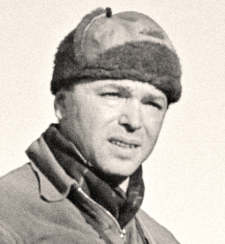
 Eliot Elisofon (April 17, 1911 – April 7, 1973) was an American documentary photographer and photojournalist. He was the photographer of the first printed T-shirt to be shown in mass media.
And, while Elisofon may be remembered by those in the screenprinting technologies for that one photograph, he was quite well known for his many other accomplishments during his life.
From the Lower East Side of New York City, Elisofon graduated from DeWitt Clinton High School in 1929 and Fordham University in 1933.
Elisofon’s childhood struggles inspired his mission as a photographer; whether photographing the neighborhood he grew up in, the poor communities in the South, or exploring other countries, the human condition remained central to his work. His humble upbringing drove Elisofon to succeed and to improve the world around him. From his perspective: “art, to be true art, must grow out of human beings and it must help human beings live a better and fuller life. It must extend the field of feeling and vision we are born with.”
He is a founding member of the Photo League in 1936. Elisofon was one of the most active and productive members: he gave guest lectures (1938–43); co-organized the Men at Work Project with Lewis Hine (1940); served periodically as president between 1939 and 1941; taught courses on photojournalism and flash photography (1940–41); and participated in numerous exhibitions.
From 1938 to 1942 Elisofon ran a commercial photography studio, August and Co., making photographs for advertising and fashion. He pursued his personal work on the side and studied the work of photographers he admired.
Early in his career, Elisofon made it his mission to “point his camera at things that needed attention.” In 1937, he met the photographer and filmmaker Willard Van Dyke who introduced him to Harper’s Bazaar art director Alexey Brodovitch, who in turn introduced him to Beaumont Newhall, the curator of photography at the Museum of Modern Art and Tom Maloney, the editor of U.S. Camera. His New York street work was exhibited at the Pennsylvania Museum of Art and the Julien Levy Gallery. In 1938 his series Playgrounds of Manhattan was exhibited at the New School. For Elisofon the series was a way to bring attention to playground conditions for children in poor neighborhoods. Elisofon befriended and photographed many artists of the period, including Chaim Gross, Isamu Noguchi and David Smith, and his studio across from the Museum of Modern Art served as a gathering place for artists. He was hired as a photographer in the Federal Writers’ Project series “These Are Our Lives” in 1939.
Elisofon taught at many institutions, including the Institute of American Artists School (1936-1941), the New School (1938), the Clarence H. White School of Photography (November 1940 – April 1941), the Photo League (1941), the New School for Social Research (1942), the Museum of Modern Art, and the School of the Art Institute of Chicago, as well as Yale University, Syracuse University, Radcliffe College, Wellesley College, and Sarah Lawrence College.
Elisofon’s first assignments for LIFE magazine appeared in 1937, Tin Type Photographer and Jewish New Year, and in 1941 his image of General Patton was the first color cover of LIFE Magazine. Patton was intrigued by Elisofon’s desire to get as close to the action as possible and nicknamed him “Hellsapopin.” He was the only photographer to accompany Gen. Patton throughout the North African Campaign. His photographs became an exhibition titled The Tunisian Triumph, which opened in June 1943 at the Museum of Modern Art and traveled to 20 cities in the United States. From 1942 to 1964 he was a staff photographer for LIFE Magazine.
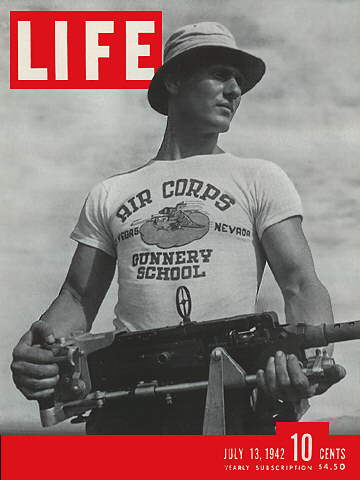 In 1942, Elisofon would take the first known photograph of a person wearing a printed T-shirt produced in mass media. The photo graced the cover of the July 13th, 1942 cover of LIFE Magazine, showing then 23-year-old Corporal Alexander LeGerda (April 24th, 1919 – August 3rd, 1998) of Lehigh Valley, Pennsylvania cradling a .30 caliber machine gun and sporting a tight-fitting athletic tee made by the American Athletic Co. in Los Angeles, CA.
While on assignment for LIFE Magazine in Hollywood, Elisofon discovered the potential to use motion picture color filters for expressive use in still photography in 1951, while photographing the film African Queen, he shared his theories on color photography with director John Huston, who subsequently hired him as the color consultant on Huston’s next film, Moulin Rouge, in 1952. Elisofon also worked as a color consultant in the 1958 film Bell, Book and Candle, starring Kim Novak, James Stewart, Hermione Gingold, Jack Lemmon, and Ernie Kovaks, and the 1965 film The Greatest Story Ever Told, by director George Stevens.
Over the years, Elisofon traveled to six continents, covering an estimated 2-million miles. His work appeared in LIFE Magazine for almost 30 years and 19 books of his work were published during his lifetime. He made 11 trips to Africa, photographing, making films, and collecting art and donated his extensive collection of African art and photographic archive of over 80,000 images to what became the National Museum of African Art in Washington, D.C. In 2013 the museum celebrated the 40th Anniversary of the Eliot Elisofon Photographic Archives and art collection with the exhibition Africa Re-Viewed: The Photographic Legacy of Eliot Elisofon.
Eliot Elisofon published many books including,
“The Technique of Wood Sculpture”, with his friend Chaim Gross, Epstein, New York, 1939
“Food is a Four Letter Word”, foreword by Gypsy Rose Lee, Rinehart, 1948
“African Folktales and Sculpture”, James Johnson Sweeny, Bollingen Series XXX11, 1953
“The Art of Indian Asia” by Heinrich Zimmer, edited by Joseph Campbell, illustrations, Bollingen Foundation, 195
“The Sculpture of Africa”, text by William Fagg, Praeger, 1955 (published in USA, England, France and Germany; this book on African sculpture is referenced by name in Daniel Olivas’s short story “Good Things Happen at Tina’s Café” featured in his collection.
“The King of Lighting Fixtures” published by the University of Arizona Press in 2017)
“Color Photography”, Viking, 1961, (published in US, England, France, Germany, Denmark and Finland)
“The Nile”, with an introduction by Laurens van der Post, Viking, 1964
“Africa’s Animals”, with Marvin Newman, Doubleday, 1967
“Hollywood Style”, text by Arthur Knight, Macmillan, 1969
“Java Diary”, MacMillan, 1969
“The Cooking of India”, text by Santha Ramma Rau, illustrations, Time/Life Books, 1969
“The Hollywood Style”, text by Arthur Knight, Macmillan, 1969
“The Cooking of Japan”, text by Rafeal Steinberg, illustrations, Time/Life Books, 1970
“A Week in Agata’s World: Poland”, Crowell-Collier, 1970
“A Week in Leonara’s World: Puerto Rica”, Crowell-Collier, 1971
“Erotic Spirituality: The Vision of Konarak”, text by Alan Watts, Macmillan, 1971, 1974
“Zaire, A Week in Joseph’s World”, Crowell-Collier, 1973
The Eliot Elisofon Photographic Archives at the Smithsonian National Museum of African Art is a research and reference center devoted to the collection, preservation, and dissemination of visual materials that encourage and support the study of the arts, cultures, and history of Africa. The archives collections contain approximately 500,000 items, including rare collections of glass plate negatives, lantern slides, stereographs, postcards, maps, and engravings. The Elisofon Archives staff works with art historians, anthropologists, photographers, filmmakers and other specialists in acquiring and preserving these visual resources.
Eliot Elisofon was married twice, first to Mavis Lyons 1940-1946, and to Joan Baker Spear in 1950, with whom he had two daughters Elin and Jill. Throughout his life, Elisofon maintained a primary residence in New York City and a summer home in Maine. Sadly, Eliot Elisofon passed away in New York City on April 7, 1973, as a result of a massive cerebral hemorrhage at the age of 61.
Copyright of Design and Photograph
For those who have or are printing the design as reproductions, you should be aware that the image on the shirt and the photo are currently protected under the U.S. and International Copyright. The original 1948 copyright, which fell under the U.S. Copyright Act of 1909, was extended first by the 1976 Copyright Act and was extended again by the 1998 Copyright Term Extension Act for a total of 95 years and thus both will be protected under copyright until at least 2043. Life Magazine, as well as the heirs of the estates of Elisofon and Legerda, can seek renewal on their rights and be granted a further extension. Applying these standards, only those works published in the United States before January 1, 1925, are in the public domain and may be reproduced without permission. Read More >>
The image shown here is allowed under the 1998 Copyright Act, as it is used for informational purposes only.