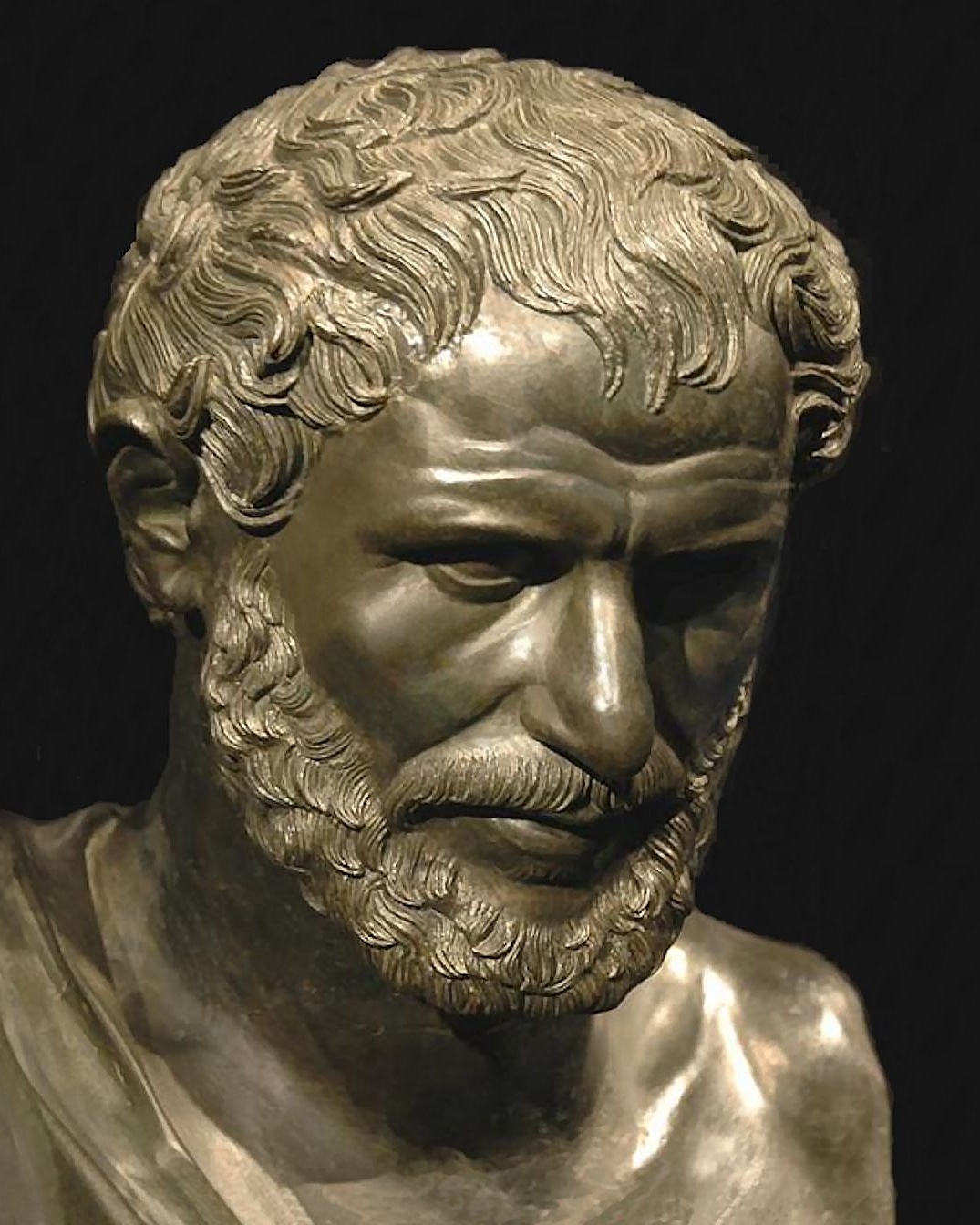
 Heraclitus of Ephesus (c.500 BCE – c.400 BCE) was born in Ephesus, Ionia, Persian Empire, which is now lçuk, İzmir, Turkey as the eldest son of a wealthy family. He became an ancient Greek pre-Socratic philosopher.
His placement in Whos Who in Screenprinting is due to Heraclitus’ concept of Panta Rhei, ‘everything flows,’ which led Eugene Cook Bingham to coin the term rheology in 1920.
Very little is known of Heraclitus. It is thought that he only produced a single written work on papyrus. The original did not survive, except in over 100 quotations by other authors. The work’s title is unknown, but many philosophers of the period refer to the work as On Nature. Heraclitus presented his book to the Artemisium as a dedication.
His philosophy is related to the flux and unity of opposites. One of his most notable applications of this idea was the concept of impermanence, as he saw the world as constantly in flux, changing as it remained the same, which he expressed in the saying, “No man ever steps in the same stream twice.” Without a full understanding of the original quote, many have found fault with the idea. In fact, one author wrote an entire book on the subject of Heraclitis’ Paradox. The full quote is:
“No man can enter the same stream twice. As the stream flows it is changed. And, as man changes constantly, he is not the same man.”
Just as it remains to this day, every author’s work takes on new meaning as others change the original words to bring the original text more in line with their current thought.
Concerning Heraclitus’ concept of Panta Rhei, ‘everything flows’, the exact phrase was not ascribed to Heraclitus until the 6th century by Simplicious of Cilicia. Diogenes Laërtius later summarized Heraclitus’s philosophy by stating, “All things come into being by conflict of opposites, and the sum of things (τὰ ὅλα ta hola (“the whole”)) flows like a stream”. Later Plato, in his Cratylus, ascribed the concept to Heraclitus as Panta Chorei, or “everything moves.”