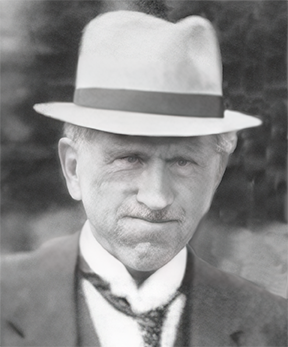
 Max Ulrich Schoop (born April 10, 1870 in Frauenfeld, Switzerland; died February 29, 1956 in Zurich, Switzerland) was a Swiss inventor who introduced the metal spraying process in 1906 and developed various aluminum welding processes. Schoop obtained a patent to flame-spray metal onto a board through a patterned mask, which led others to find new ways to create printed circuit boards.
His father, Ulrich Schoop, moved from Dozwil to Frauenfeld in 1863, where he worked as a drawing teacher. In 1876 the family settled in Zurich, where he was awarded the title of Professor as a teacher at the Zurich School of Applied Arts.
Max Ulrich’s brothers were the electrochemist Paul Schoop (around 1858–1907) and the journalist Friedrich Maximilian Schoop (1871–1924), who, together with his wife Emma, had the children Max (1902–1984; Trude Berliner), Trudi, Hedi (1906–1995 ceramist; Friedrich Hollaender and Ernö Verebes) and Paul (1907–1976; composer). Emma followed her children to California in the 1930s.
Max Ulrich Schoop graduated from school in Zurich and, in 1885, began training in graphics at Wilhelm Cronenberg’s institute in the Allgäu. Back in Switzerland, he worked as an assistant to a photographer and in La-Chaux-de-Fonds as a portrait retoucher.
When his brother Paul was director of a battery factory in the 1890s, Max Ulrich was sent to the Moscow branch in 1893 as a fitter. After surviving appendicitis, he was employed as a private tutor for French in Nizhny Novgorod. He also learned Russian and translated works by Leo Tolstoy.
In 1895 he began studying physics and electrical engineering at ETH Zurich. Soon he was working again in the accumulator business at Schöller in Vienna and as head of the laboratory at Hagen in Cologne.
On August 23, 1898, he married Martha Bächler, with whom he had five children. When his son Uli Schoop was born in 1903, he was employed as head of the laboratory at the Accumulator Works in Cologne. The family moved to Paris the same year, where he worked as a laboratory manager for the automobile manufacturer Dinin.
In 1903, Schoop went to Paris to join the Dinin automobile manufacturer, where, as Laboratory Chief, he succeeded in autogenous aluminum welding after 800 attempts. In 1907 he traveled to the USA to market his aluminum welding invention, which ended in a business fiasco.
In the spring of 1909, he watched his children shoot “lead bullets” in the Bois-Colombes park. A lead coating had formed on the garden wall where the lead bullets splattered. Schoop then undertook experiments with small cannons, tin, and lead granules (metal grains obtained by granulation). On April 28, 1909, he registered his basic patent for the metal spraying process in Berlin, granted four ye
ars later. Patent disputes followed, so his patent was only awarded after six years in the last instance at the Reichsgericht in Leipzig.
In 1910 Schoop returned to Zurich and opened his laboratory, where he further developed thermal spraying. To finance this, he founded two companies that manufacture Schoop’s metal spray guns and, on the other hand, offered contract metallization. The technical manager of the works for metallization Franz Herkenrath was helpful. “Metal spraying, invented by the Swiss Max Ulrich Schoop, is any thermal process in which metals in powder or wire form are melted, atomized simultaneously, and sprayed onto a suitably prepared surface.” In March 1919, Schoop had a patent from his colleague Frieda Neininger. Among other things, the contacting of the end faces of film capacitors are based on his process.
In 1914 he received the John Scott Medal from the University of Philadelphia. The Technical University of Braunschweig awarded him a doctorate.
After his divorce in 1927, he married his colleague Neininger on December 21, 1929. Since none of his children could or wanted to continue his work, Schoop liquidated his laboratory in 1945