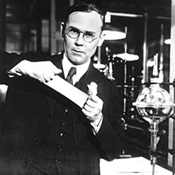
 Wallace Hume Carothers (April 27, 1896 – April 29, 1937) was an American chemist, inventor, and the leader of organic chemistry at DuPont, credited with the invention of nylon
Carothers was a group leader at the DuPont Experimental Station Laboratory near Wilmington, Delaware, where most polymer research was done. Carothers was an organic chemist who, in addition to first developing nylon, also helped lay the groundwork for Neoprene. After receiving his Ph.D., he taught at several universities before DuPont hired him to work on fundamental research.
Early Life and Education
Carothers was born on April 27, 1896, in Burlington, Iowa, to Ira and Mary Evalina Carothers. He was the oldest of four children. He had one brother and two sisters: John, Isobel, and Mary. As a youth, Carothers was fascinated by tools and mechanical devices and spent many hours experimenting. He attended public school in Des Moines, Iowa, where he was known as a conscientious student. After graduation and under pressure from his father, Carothers enrolled in the Capital City Commercial College in Des Moines, (where his father was Vice-President) at the college, completing the accountancy and secretarial curriculum in July 1915.
In September 1915, he entered Tarkio College in Missouri. Although he initially majored in English, he switched to chemistry under the influence of Arthur Pardee, head of that department. Carothers so excelled in chemistry that before graduation, he was made a chemistry instructor and studied for and taught the senior course when Pardee left to become chairman of the chemistry department at the University of South Dakota. He graduated from Tarkio in 1920 at 24 with a bachelor of science degree. Then he went to the University of Illinois for his master of arts degree, which he received in 1921 under the guidance of Professor Carl Marvel.
During the 1921–22 school year, Carothers held a one-year appointment as a chemistry instructor at the University of South Dakota. At the University of South Dakota, he began his independent research that resulted in an article accepted by the Journal of the American Chemical Society. In this paper, he measured the physical properties of phenyl isocyanate and diazobenzene-imide (now known as phenyl azide). The properties have very similar values, which led him to the conclusion that the structure of the second compound is C6H5-N=N=N, with the three nitrogen atoms in a linear chain rather than a ring, as previously thought.
He returned to the University of Illinois to study for his Ph.D. under Roger Adams. His degree was awarded in 1924. He specialized in organic chemistry and minored in physical chemistry and mathematics. He worked as a research assistant during 1922–1923 and received the Carr Fellowship for 1923–24. This was the most prestigious award offered by the university at that time.
Career
After receiving his Ph.D., Carothers stayed at the University of Illinois for two years as an instructor in organic chemistry.
In 1926 Carothers moved to Harvard University. Again he was an instructor in organic chemistry. James B. Conant, who became President of Harvard College in 1933, said of Carothers:
In his research, Dr. Carothers showed even at this time the high degree of originality which marked his later work. He was never content to follow the beaten path or to accept the usual interpretations of organic reactions. His first thinking about polymerization and the structure of substances of high molecular weight began while he was at Harvard.
In 1927, DuPont decided to fund fundamental, pure research: research not deliberately aimed at developing a money-making product. Carothers traveled to Wilmington, Delaware, to discuss the possibility of being in charge of organic chemistry at the new DuPont laboratory for fundamental research.
DuPont
The decision to leave academia was difficult for Carothers. At first, he refused DuPont’s offer of employment, explaining that “I suffer from neurotic spells of diminished capacity which might constitute a much more serious handicap there than here.” Despite this admission, a DuPont executive, Hamilton Bradshaw, traveled to Harvard and convinced Carothers to change his mind. His salary was $500 monthly compared to only $267 at Harvard ($3200 annually).
Later in a letter to Wilko Machetanz, his Tarkio roommate, Carothers expanded on his feelings of depression: “I find myself, even now, accepting incalculable benefits proffered out of sheer magnanimity and goodwill and failing to make even such trivial return as circumstances permit and human feeling and decency demand, out of obtuseness or fear or selfishness or mere indifference and complete lack of feeling.”
Neoprene
Carothers began working at the DuPont Experimental Station on February 6, 1928. His primary goal was to synthesize a polymer with a molecular weight of more than 4,200, the mass achieved by Dr. Emil Fischer.
By the summer of 1928, Carothers boasted a small staff of Ph.D. chemists and two consultants: Dr. Roger Adams, his thesis advisor, and Dr. Carl Marvel, his organic chemistry instructor at the University of Illinois. The laboratory where these top scientists worked became known as “Purity Hall.” It was discouraging that by the middle of 1929, “Purity Hall” had not produced a polymer weighing much over 4,000.
In January 1930, Dr. Elmer K. Bolton became assistant chemical director in the chemical department and, thus, Carothers’ immediate boss. Bolton wanted practical results in 1930, and his wish was fulfilled. Bolton asked Carothers to examine the chemistry of an acetylene polymer to create synthetic rubber. In April 1930, one of Carothers’ staff, Dr. Arnold M. Collins, isolated chloroprene, a liquid that polymerized to produce a solid material that resembled rubber. This product was the first synthetic rubber and is known today as Neoprene.
Polyesters
In the same year, Dr. Julian Hill, another member of the Carothers team, began work again on attempting to produce a polyester with a molecular weight of above 4,000. His efforts were soon met with great success when he produced a synthetic polymer with a molecular weight of about 12,000. The high molecular weight allowed the melted polymer to be stretched out into strings of fiber. Thus was created the first synthetic silk described by the chemists as a super polyester.
Polyesters and polyamides are examples of condensation polymers formed by step-growth polymerization. Carothers worked out the theory of step-growth polymerization and derived the Carothers equation, which relates the average degree of polymerization to the fractional conversion (or yield) of monomer into polymer. This equation shows that for a high molecular weight, a very high fractional conversion is needed (for step-growth polymers only).
Hill also produced a synthetic fiber that was elastic and strong by combining glycols and diacids and heating under reduced pressure, using a molecular still to remove the last traces of water produced in the condensation reaction. Unfortunately, the fiber produced could not be commercialized because it reverted to a sticky mass when placed in hot water. Carothers dropped his research on polymers for several years.
Depression
In 1931, Carothers moved into a house in Wilmington, Whiskey Acres, with three other DuPont scientists. He was no recluse, but his depressive moods often prevented him from enjoying all the activities his roommates participated in. In a letter to a close friend, Frances Spencer, he said, “There doesn’t seem to be much to report concerning my experiences outside of chemistry. I’m living out in the country now with three other bachelors, and they are socially inclined and have all gone out in tall hats and white ties while I sit sullenly at home after my ancient custom.” At about this time, Carothers showed Julian Hill that he had kept a capsule of cyanide attached to his watch chain.
Carothers hated the public speaking that was necessary to maintain his high profile. In a letter to Frances Spencer in January 1932, he said, ” I went up to New Haven during the holidays and made a speech at the organic symposium. It was well received, but the prospect of making it ruined the preceding weeks. I needed to resort to considerable alcohol to quiet my nerves for the occasion. … My nervousness, moroseness, and vacillation get worse as time goes on, and the frequent resort to drinking doesn’t bring about any permanent improvement. 1932 looks pretty black to me just now.”
In 1932, the agreement under which Carothers was hired was modified by Dr. Bolton. “Purity Hall” would now focus on “effecting a closer relationship between the ultimate objectives of our work and the company’s interests.”This meant that funds were shifted from pure research to practical research. Carothers did not see himself as a skilled commercial researcher. He proposed that fundamental work be limited to two or three proposals, consistent with DuPont’s interests.
Personal life
Carothers’s personal life during this time was busy. He was having an affair with a married woman, Sylvia Moore, who, with her husband, filed for divorce in 1933. At the same time, he worried about his parents’ financial problems and planned to bring them to Wilmington. With no thought of the possible emotional ramifications of this move, he bought a house in Arden about ten miles (16 km) from the Experimental Station and moved into it with his parents. He was 37 at the time. Interactions with his parents soon became tense. Carothers was still seeing Sylvia Moore, who was now single, and his parents highly disapproved of this relationship. Finding the tension in the household too wearing, his parents returned to Des Moines in the spring of 1934.
Polyamides
In 1934, Carothers turned his attention to fibers again. Now the team substituted diamines for glycols to produce a polyamide type of polymer. These substances were much more stable than the polyesters formed by using glycols. The ability of polyamides to form crystalline domains through hydrogen bonding gives them increased mechanical properties. Therefore they might produce synthetic silk that would be practical for everyday use. His research resulted in the invention of several new polyamides. Dr. W.R. Peterson and Dr. Donald Coffman conducted the lab work for this project. In 1935 Dr. Gerard Berchet was assigned to this polyamide research.
During this productive period of research, in the summer of 1934, before the eventual invention of nylon, Carothers disappeared. He did not go to work, and no one knew where he was. He was found in a small psychiatric clinic, Pinel Clinic, near the famous Phipps Clinic associated with Johns Hopkins Hospital in Baltimore. He had become so depressed that he drove to Baltimore to consult a psychiatrist, who put him in the clinic.
Nylon
Shortly after his release from the clinic, Carothers returned to DuPont. Bolton instructed Carothers to work on polyamides.
Carother’s work in linear super-polymers began as an unrestricted foray into the unknown with no practical objective. But the research was in a new field in chemistry, and Du Pont believed that any new chemical breakthrough would likely be of value to the company. During the research, Carothers obtained some super-polymers that became viscous solids at high temperatures. The observation was that filaments could be made from this material if a rod were dipped in the molten polymer and withdrawn. At this discovery, the project’s focus shifted to these filaments, and `Nylon` was the result.
On February 28, 1935, Gerard Berchet, under the direction of Carothers, produced a half-ounce of polymer from hexamethylenediamine and adipic acid, creating polyamide 6-6. The number 6-6 came from each repeat unit of the polymer chain with two stretches of carbon atoms, each six carbon atoms long.
The new product was announced the same day in New York (NY) and London (LON), and thus, the substance would become known as Nylon. It was challenging to work with because of its high melting point, but Bolton chose this polyamide to develop commercially. He selected Dr. George Graves to work with Carothers on the project. Eventually, Graves supplanted Carothers as the leader of the polyamide project. In addition, dozens of chemists and engineers worked on refining polyamide 6-6 into a viable commercial product.
This was the first genuinely revolutionary fiber. Unlike other man-made fibers like Rayon and acetate, which had been derived from plant cellulose, nylon was synthesized completely from petrochemicals and established the basis for the ensuing discovery of an entirely new world of manufactured fibers.
DuPont began commercial production of nylon in 1939, with the first experimental testing of nylon being in the thread used to sew parachute fabric and in women’s stockings, with the first ‘Nylon stockings’ being shown in February 1939 at the San Francisco Exposition. However, the first nylon product was a toothbrush. Unfortunately for millions of women who suddenly found cheap tights, the onset of World War II cut short this new market, as all nylon was allocated to military use.
During the War with Japan, nylon replaced Asian silk in parachutes – as much of the Asian silk market was, unfortunately, flying under a Japanese flag and also found widespread use in tires, tents, ropes, ponchos, and other military supplies, and even used in the production of a high-grade paper for US currency.
The outcome of this was that although by the outset of the War, cotton was king of fibers, by the end, manufactured fibers had taken 15% of the market.
It could be said that the man-made fibers helped to win the War, and with the War over, the vast war industry switched over to peacetime production, beginning, as you would guess, with stockings (hurray), but soon spread into other growth areas such as carpeting and automobile upholstery, as people returned to day-to-day life in the boom times of post-War America. By the 1950s, man-mades were taking up 20% of the fiber needs of textile mills, with another new fiber called ‘Acrylic’ being added, an offshoot of nylon with wool-like qualities.
Marriage and decline
On February 21, 1936, Carothers married Helen Sweetman, whom he had been dating since 1934. Sweetman had a bachelor’s degree with a chemistry major and worked for DuPont on preparing patent applications.
Soon after, on April 30, 1936, Carothers was elected to the National Academy of Sciences, a very high honor. Carothers was the first industrial organic chemist to receive this honor. Yet by June 1936, despite this honor which validated his contributions to science, Carothers could not shake the depression that prevented him from working. In early June, he was admitted involuntarily to the Philadelphia Institute of Pennsylvania Hospital, a prestigious mental hospital, where his psychiatrist was Dr. Kenneth Appel. One month later, he was permitted to leave the institute to go hiking in the Tyrolean Alps with friends. The plan was for him to day hike with Dr. Roger Adams and Dr. John Flack for two weeks. After they left, he stayed on, hiking alone, without saying a word to anyone, even his wife. On September 14, 1936, he suddenly appeared at her desk at the Experimental Station. From then on, Carothers was not expected to perform actual work at the Experimental Station. He would often go in and visit. He began living in Whiskey Acres again after his wife had agreed with Dr. Appel that she was not strong enough to watch over Carothers.
On January 8, 1937, Carothers’ sister Isobel died of pneumonia. Wallace and Helen Carothers traveled to Chicago to attend her funeral and then to Des Moines for her burial. He still traveled to Philadelphia to visit his psychiatrist, Dr. Appel, who told a friend of Carothers that he thought suicide was the likely outcome of Carothers’ case.
On April 28, 1937, Carothers went to the Experimental Station to work. The following day he committed suicide in a hotel room in Philadelphia by taking cyanide dissolved in lemon juice, knowing that ingesting cyanide in an acidic solution would greatly intensify the speed and effect of the poison. No note was found.
Despite his success with nylon, he felt he had not accomplished much and had run out of ideas. His unhappiness was compounded by the death of his sister, Isobel, and on the morning of April 28, 1937, he went to the Experimental Station to work. The following day he checked into a Philadelphia hotel room. He committed suicide by drinking a cocktail of lemon juice laced with potassium cyanide, knowing that the acidic solution would greatly intensify the speed and effect of the poison. No note was found. His daughter, Jane, was born seven months later, on November 27, 1937.