Currently the dollar is enjoying a higher exchange rate, which is a good sign for those who want to invest in a new car, home, investment property, or a business. However, it is important to learn how to avoid taking an unnecessary hit on any transfers into Mexico.
First and foremost, while you can bring in up to $10,000 in cash into Mexico, the banks in Mexico no longer accept dollars. The only way to change the $10,000 into pesos is to go to one of the Casa de Cambio, with will change a limited amount of dollars per day at a higher rate. This can be done at the airport upon arrival where you get a rate lower than the Casa de Cambio in Cuernavaca. As the rate vary at the Casa de Cambio at the airport, it is necessary to shop around for the best rate.
There is some confusion about transferring dollars into Mexico. For example, banks do not transfer Pesos or Dollars per se; they make electronic transfers that normally go through a clearing house, such as the Automated Clearing House (ACH). ACH is a network run by the National Automated Clearing House Association (NACHA) that allows banks and other financial institutions to send and receive money. NACHA is an independent organization owned by many banks, credit unions, and payment processing companies.
Most individuals know ACH Direct Deposit, where an employer directly deposits an employee’s bank account for payroll purposes. They may also be mindful of ACH Direct Payment, which Social Security most often uses to move funds each month into recipients’ accounts.
When the transfer happens between two banks using different currencies, the foreign exchange rate comes into play. The number one rule is to avoid paying an exchange rate by not transferring money into a foreign currency. If this is not a viable solution, then study the different ways to exchange currencies and especially when to make the best transfer.
Exchange Rate
There is little reason to worry about the foreign exchange rate on small amounts, but as the amount of the currency being transferred increases, so does the cost of the exchange. This can be problematic if one attempts to buy a new car or home using transferred funds.
If one were planning on buying a MXN 665,000 car at an exchange rate of 20:1 (20mxn:1usd), the cost would be USD 32,250. If you wait one day and the exchange rate moves to 19:1 (19mxn:1usd), the car will cost MXN 665,000, i.e., USD 35,000 or USD 1,750 more.
When buying a home in Mexico, the exchange rate can be substantial. The median sales price for a property in Cuernavaca is approximately MXN 4,380,000 (USD 230,526). This price reflects the general cost of properties in Cuernavaca, but individual homes can vary significantly based on location, size, amenities, and condition. A 1356 sq ft (126 m²) apartment with 2 bedrooms and 2 bathrooms located in Chulavista may cost only MXN 2,654,319.
If the MXN 4,380,000 home were purchased on 16 April 2025 when the exchange rate was 19:1 the cost would be USD 230,526. If it were purchased on 8 April 2025 when the exchange rate was 20.84:1, the cost would have been USD 219,000, saving the buyer USD 11,526. The larger the gap in exchange rates, the higher the savings are.
Thus, expats should watch the foreign exchange rate closely when making substantial purchases or transferring funds into Mexico.
It is best to make direct monthly payments into a bank account in your country of origin and transfer funds as needed when a higher foreign exchange rate is possible.
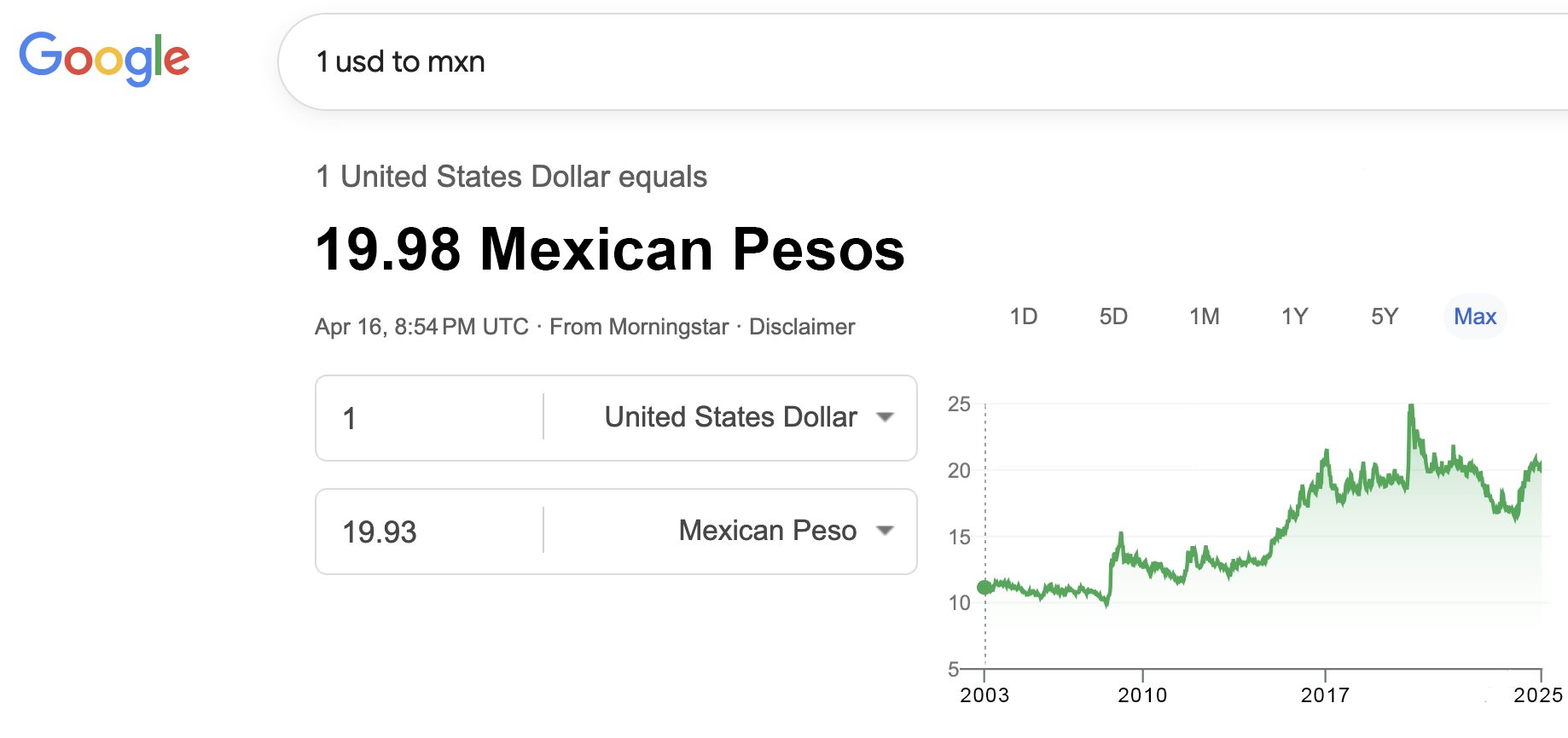
For example, the foreign exchange rate on 16 April 2025 is 1 USD to 19.98 MXN. A USD 2,000 transfer made today would net MXN 39,960.
The same USD 2,000 transfer on April 8 had an exchange rate of 1 USD to 20.84 MXN, netting MXN 41,680, for a difference of +MXN 1,720.
By using direct deposit, you are opening yourself up to potential losses. If you want the best return on your finances, check the foreign exchange rate daily, and when it goes up, make the transfer rather than gamble on the higher rate with a fixed direct transfer.
Banking
While it is normally difficult to avoid the exchange rate when transferring funds, you can be aware of the international transfer fees. It is best to have a bank in your country of origin that does not charge international transfer fees. Some of the banks in Cuernavaca that are affiliated with foreign banks are BBVA, CitaBanamex (which is soon to be just Banamex after Citi’s planned sale), Scotiabank. Other banks like Bank of America (partners with Scotiabank) and JPMorgan Chase have a limited presence, primarily for institutional clients. It is necessary to discuss the type of account needed to avoid the transfer fees with both the foreign and local banks to ensure that you will not be charged a bank transfer fee.
Finding the Exchange Rate
You can enter “1 USD to MXN” into your browser’s URL window and see the foreign exchange rate each day.
Paying Workers and Contractors
Money transfers to other countries outside the United States were nearly 30 times higher than money received last year. Remittances refer to cross-border payments to family or friends and are often associated with migrant workers sending money back home to friends or relatives back in their communities of origin. It is estimated that about one in seven people worldwide are involved with remittances – substantially impacting payment behavior in, especially, Asia and Latin America. For the United States, the top five recipient countries for remittances include India, Mexico, Guatemala, the Philippines, and China. The five main sources for remittances in the U.S. were Mexico, Canada, the UK, Puerto Rico, and Germany. In 2023, Mexico received USD 63.3 billion in remittances, accounting for roughly 7.5 percent of global remittance flows and establishing the country’s position as the second-largest destination for such funds worldwide. As a reminder, before assuming that the remittances are costly to the USA, those migrants in the USA, are paying an average of 27% in taxes in the USA on the money they remit to help their families, which produces an income to the USA government of US 17 billion.
Avoid paying workers and contractors from the funds that you transfer into Mexico to reduce your losses on bank transfers. It is possible to make direct electronic payments to workers in Mexico from some US account without paying a transfer fee.
However, the exact method and fees can vary depending on the specific financial institutions involved and the type of transaction. Some financial institutions in the US may offer services like Directo a México or international ACH, which facilitate these transfers, and some may not charge fees for these specific types of transfers.
PayPal – Taking a clue from online storefronts, perhaps the easiest and often the least expensive way to pay International employees is through PayPal. Use Paypal for sending international personal transactions. The applicable fee for sending domestic transactions applies plus the applicable additional percentage-based fee for international transactions (international fee). The current fees at the time of this writing are 5%, with a minimum international fee of USD 0.99 and a maximum of USD 4.99. Paypal also offers options for local bank transfers through Xoom for those without PayPal accounts.
Directo a México or Direct Payment: This service, offered by certain financial institutions, allows for direct remittances to Mexico, and beneficiaries in Mexico do not typically pay a fee for receiving the funds, according to the Banco de México. At some institutions, the sender may be charged a fee for the service, though. Check with your bank to see if they offer Direct to Mexico, or Direct Payment transfers.
International ACH (Automated Clearing House) transfers: Some banks offer international ACH transfers to Mexico, which can be a cost-effective way to send money. ACH transfers are electronic payments that move money between bank accounts.
Other options: Other services like Wise may also offer international transfers with minimal fees, particularly for paying independent contractors.
Factors affecting fees: Banks may charge fees for international transfers, including wire transfer fees.
Currency conversion: The exchange rate used to convert currencies can also impact the final amount received, and some services may have additional exchange rate margins.
Platform fees: Some platforms or services may charge their own fees for facilitating the transfer, regardless of the bank’s fees.
Check with your bank: The best way to determine if you can make direct electronic payments to Mexico without fees is to contact your bank and inquire about their international transfer options and associated fees.
Several services cater to making direct payments to workers outside the USA, including international bank transfers, money transfer services like PayPal and Wise, and global payroll providers like Deel. Additionally, employer of record (EOR) services can handle the entire payroll process in the worker’s home country.
How the Exchange Rate is Determined in Mexico
Banco de Mexico determines the exchange rate (FIX) as an average of quotes in the wholesale foreign exchange market for operations payable in 48 hours. Banco de México informs the FIX from noon onwards each banking day. It is published in the Official Gazette (Diario Oficial de la Federación) one banking business day after its determination date. It is used to settle liabilities denominated in U.S. dollars payable in Mexico on the day after publication in the Official Gazette.
The foreign exchange rate changes each second, 24 hours a day. Since the end of 1994, the Foreign Exchange Commission in Mexico has been the responsibility of officials from the Ministry of Finance and Banco de México. However, the Mexican peso closing foreign exchange rate is determined as the weighted average of the exchange rates that occur in a continuous random sample of three minutes within a ten-minute window between 1:55 p.m. and 2:05 p.m. of each banking business day. Banco de México publishes the Mexican peso closing foreign exchange rate at 2:10 p.m. every banking business day.
These exchange rates are published by Banco de México for informational purposes only and do not have official validity. Cross-exchange rates, converted into Mexican pesos using the Banco de México FIX exchange rate and market-average U.S. dollar equivalents for the euro and Japanese yen, are published daily by the International Monetary Fund (IMF). Whether a holiday day in the U.S. or the IMF remains closed, the exchange rates are collected directly from Reuters, the data source used by those above international financial organizations. The Bank of Canada publishes the exchange rate for the Canadian dollar on its official website.