All employers in Mexico have legal financial requirements for their employees, including the payment of mandatory government fees at both the national and state levels.
Domestic work has a long history in Mexico, dating back to post-colonial labor systems. The formal recognition and protection of domestic workers’ rights, however, began to take shape in the early 20th century and was significantly advanced by recent legal reforms in 2019.
Illegal informal employment remains a widespread economic phenomenon in Mexico; however, it is not recognized as a legal form of employment, as it often bypasses mandatory labor laws and social security obligations. Employers are required by law to register all employees and provide formal benefits.
Mexican labor law protects formal employees. A formal employment relationship involves:
A written contract.
Registration with the Mexican Social Security Institute (IMSS) or tax authorities.
Access to mandatory benefits such as healthcare, pensions, paid leave, end of year bonuses (Aguinaldo), and protection against unfair dismissal.
Mexican authorities, including the Ministry of Labor and Social Welfare (STPS) and the IMSS, conduct inspections and impose fines on those that fail to comply with formal employment regulations.
However, the law does recognize some aspects of informal work, particularly for self-employed individuals, who operate under civil or commercial agreements rather than labor law, provided there is no “subordination” (employer control over work performance, hours, and location). In cases where a worker is technically self-employed but is actually working under conditions of subordination, labor authorities may reclassify the relationship as a formal employment one to ensure the worker’s protection.
Key Modern Reforms (2019)
The pivotal moment for modern domestic worker rights in Mexico occurred in 2019, following a landmark Supreme Court ruling in December 2018 that declared their exclusion from social security unconstitutional. This led to a series of legislative and international actions:
Federal Labor Law and Social Security Law Reforms: In July 2019, reforms were made to the Federal Labor Law and the Social Security Law to guarantee the rights of domestic workers, including a written contract, limits on working hours, weekly rest, paid vacation, minimum wage, year-end bonus, and social security coverage.
Mandatory Social Security: A pilot program for mandatory enrollment in the Mexican Social Security Institute (IMSS) was launched in April 2019, followed by legislation making the enrollment obligatory.
International Labour Organization (ILO) Convention 189: In December 2019, the Mexican Senate ratified ILO Convention 189 concerning decent work for domestic workers, a critical step that further solidified these rights into law.
These changes moved domestic work in Mexico from a system based on informal arrangements to one with legally recognized labor rights and social protection.
Today, it is a legal obligation for employers to register domestic workers (known officially as personas trabajadoras del hogar) with the IMSS. Domestic workers encompass a diverse range of professionals, including caregivers, cooks, housekeepers, cleaners, gardeners, chauffeurs, guards, and others. An important note is that the employers may not create a title for an employee in an attempt to avoid incurring the legal obligation.
These are tripartite contributions, with the employer covering the majority, a portion covered by the worker via a wage deduction, and a third portion covered by the national and state governments.
For the income tax (ISR) with the Tax Administration Service (SAT), the employer is generally not required to withhold this tax from their wages. The employee is, however, still obligated to report their income to the SAT and may need to file an annual tax return if their income exceeds certain thresholds.
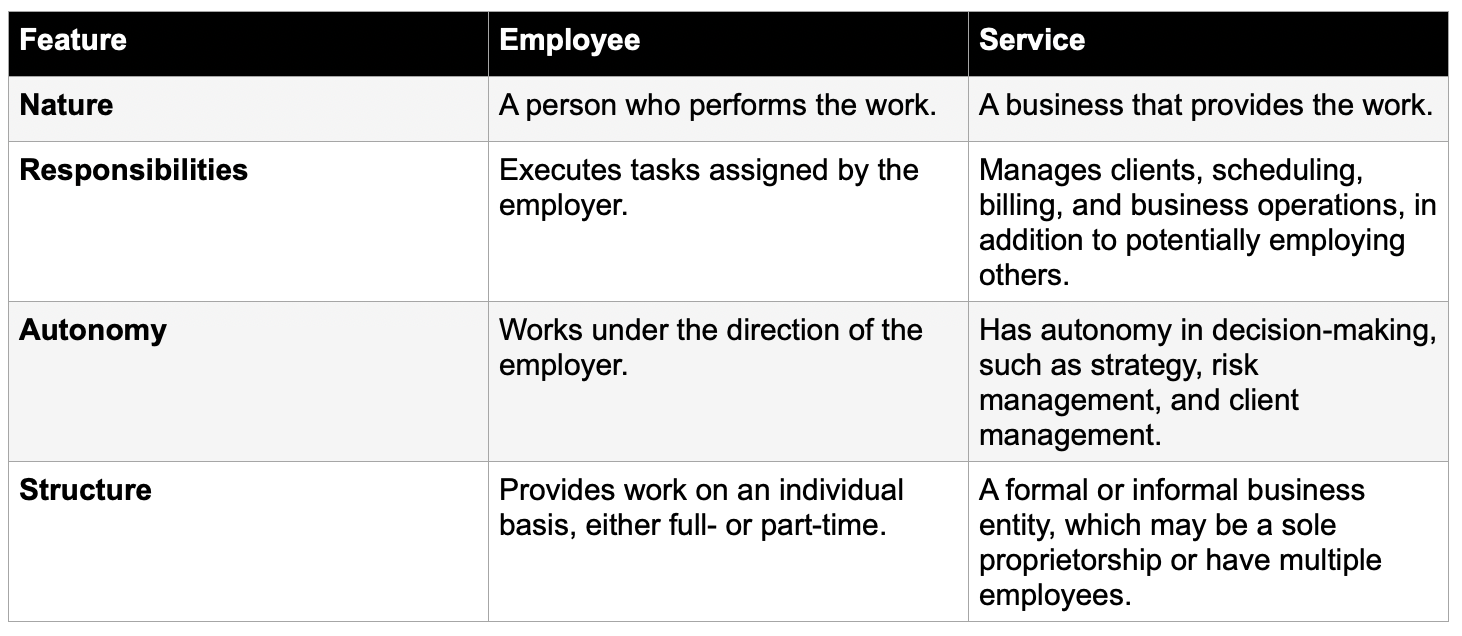
Difference of Employees and Services
An employee is an individual hired by a company or individual, while a service is the company or entity that provides the service. An employee performs the day-to-day tasks, whereas the gardening service manages the business, its clients, and the overall delivery of the service.
Mandatory Employer Obligations
RFC Number: The employer must have a Federal Taxpayers Registry (RFC) number to comply with tax obligations.
Social Security (IMSS)
Employers contribute to a system that covers health, disability, and retirement benefits. The employer’s portion is a significant percentage of the employee’s salary, ranging from approximately 25% to over 30% depending on factors like salary level.
National Housing Fund (INFONAVIT)
Employers must contribute 5% to 6% of the employee’s salary to a housing fund that allows employees to access housing loans.
State Payroll Tax
This tax is levied in every state and ranges from 1% to 3% of the employee’s salary.
Retirement Savings (SAR)
Employers contribute to a retirement savings program. Employers’ cost for the Retirement Savings (SAR) system in Mexico includes a mandatory wage base of 2% contribution for the basic retirement fund.
Old Age and Lay off Fund (CEAV)
3.15% of the employee’s wage base.
Profit-Sharing (PTU)
Employers are required to distribute 10% of the company’s pre-tax profits among employees annually.
Year-End Bonus (Aguinaldo)
Employees are entitled to the year-end bonus, which must be at least 15 days’ worth of salary, paid by December 20th each year.
Vacation Premium
Employers must pay a vacation premium of at least 25% of the employee’s regular salary for their vacation days.
Recent and Future Increases
There have been, and will continue to be, reforms to gradually increase these contributions. Starting in 2023, there was an incremental rise in the employer contribution, reaching 15% by 2030.
Other Obligations
Payment
Wages must be paid on time. The payment frequency is often bi-monthly (on the 15th and last day of the month).
Employment Contract
A written contract is required for all employees, outlining the job description, salary, payment terms, and other relevant conditions.
ISR Withholding
Private employers are not legally obligated to withhold federal income tax (ISR) from a household employee’s wages.
SAT Obligations
While the employer does not withhold ISR, the employee has the following responsibilities regarding the SAT:
RFC Number: The employee must have a Federal Taxpayers Registry (RFC) number to comply with tax obligations.
Income Tax Return: The income received is considered taxable. The domestic worker may be required to file an annual income tax return and pay taxes directly to the SAT if:
They have a single employer and their annual income exceeds a certain limit (around MXN 400,000 as a general rule for this type of income, although specific thresholds may vary).
They work for two or more employers and their total income exceeds a lower combined annual limit.
No VAT: Employee services are generally not subject to Value Added Tax (IVA).
Employers can use the official IMSS website’s tools and information to register their employees and calculate the specific monthly contributions. The IMSS website for domestic workers provides detailed guidance.
Disclaimer: Viva Cuernavaca does not provide professional opinions or advice specific to the facts and circumstances of individual readers. The reader bears full responsibility to determine the applicability of the output generated and to confirm its accuracy.


Author: G. William Hood
Author, Columnist, Educator, Epistemologist, and Publisher