In 1920, a significant political transition in Mexico marked the end of the violent phase of the Mexican Revolution (1910–1920) with the assassination of President Venustiano Carranza, an intervening provisional presidency, and the election of Álvaro Obregón, a revolutionary general who brought a period of stability and post-revolutionary reform.
Key events in Mexican politics in 1920 include:
The Plan of Agua Prieta: On April 23, 1920, the Sonoran revolutionary generals Álvaro Obregón, Plutarco Elías Calles, and Adolfo de la Huerta, who had become a powerful faction known as the “Sonoran Dynasty,” launched a rebellion against President Carranza. Carranza had attempted to impose a civilian, Ignacio Bonillas, as his successor, which the generals rejected as a violation of revolutionary principles and the “no-reelection” clause of the 1917 Constitution (which applied to consecutive terms).
Assassination of Venustiano Carranza: As support for his government collapsed, Carranza fled Mexico City in May 1920, attempting to reach Veracruz and establish a rival government. He was ambushed and assassinated in Tlaxcalantongo, Puebla, on May 21, 1920.
Provisional Presidency of Adolfo de la Huerta: Following Carranza’s death, Adolfo de la Huerta assumed the role of provisional president on June 1, 1920. During his brief term, de la Huerta successfully negotiated the surrender and amnesty of revolutionary leader Pancho Villa, helping to promote peace.
Election of Álvaro Obregón: A general election was held on September 5, 1920, which Álvaro Obregón won in a landslide with over 95% of the popular vote.
Obregón Assumes Office: Obregón took the oath of office on December 1, 1920, becoming the first stable president since the revolution began a decade earlier. His inauguration marked the beginning of a period of post-revolutionary consolidation (1920–1940) where state power became more centralized and the reforms outlined in the 1917 Constitution, such as land reform and public education, began to be implemented.
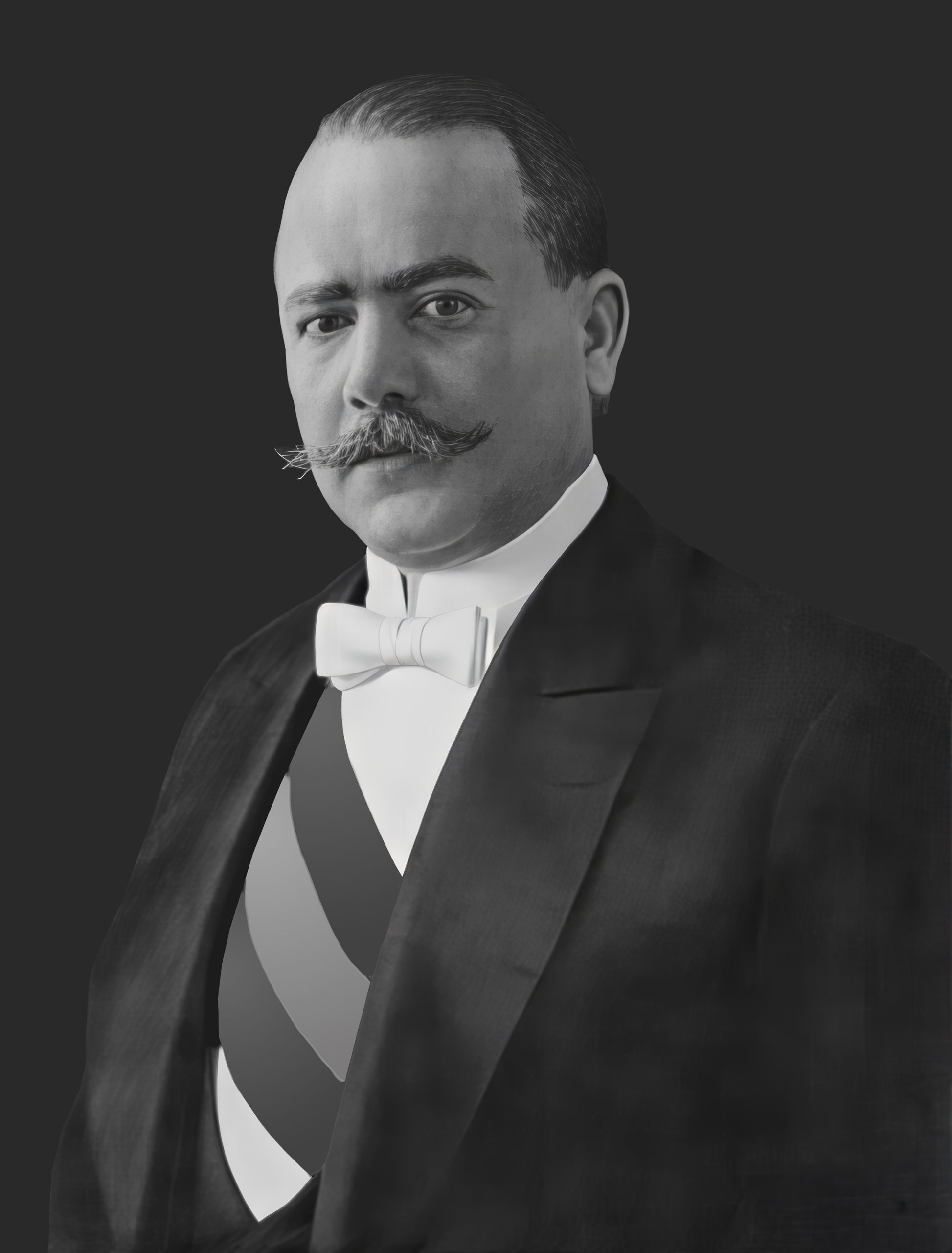 Álvaro Obregón Salido (19 February 1880 – 17 July 1928) was a Mexican general, inventor and politician as a member of the social democratic Mexican Laborist Party, (Partido Laborista Mexicano, PLM) who served as the 46th President of Mexico from 1920 to 1924. Obregón was re-elected to the presidency in 1928 but was assassinated before he could take office.
Obregón was no stranger to violence, having served as a general after joining the Revolution after the February 1913 coup d’état that brought General Victoriano Huerta to the presidency. Obregón supported Sonora’s decision to follow Governor Venustiano Carranza as leader of the northern revolutionary coalition, the Constitutionalist Army, against the Huerta regime. Obregón quickly became the most prominent general in the Constitutionalist Army, alongside Pancho Villa. Carranza appointed Obregón commander of the revolutionary forces in northwestern Mexico. Obregón lost his right arm
It is difficult to determine the exact number of people who died specifically between the defeat of Huerta in July 1914 and the formal dissolution of the Federal Army in August 1914. However, the final, decisive battles that directly led to these events were extremely bloody:
The pivotal Battle of Zacatecas on June 23, 1914 (just before the period specified), resulted in an estimated 6,000–7,000 federal troops killed and 3,000 captured, versus 1,200–3,000 Constitutionalist casualties.
In early July, the Battle of Orendaín, Jalisco, saw General Álvaro Obregón’s forces defeat federal troops, leaving approximately 8,000 federal soldiers dead. This defeat made the collapse of the Huerta regime inevitable.
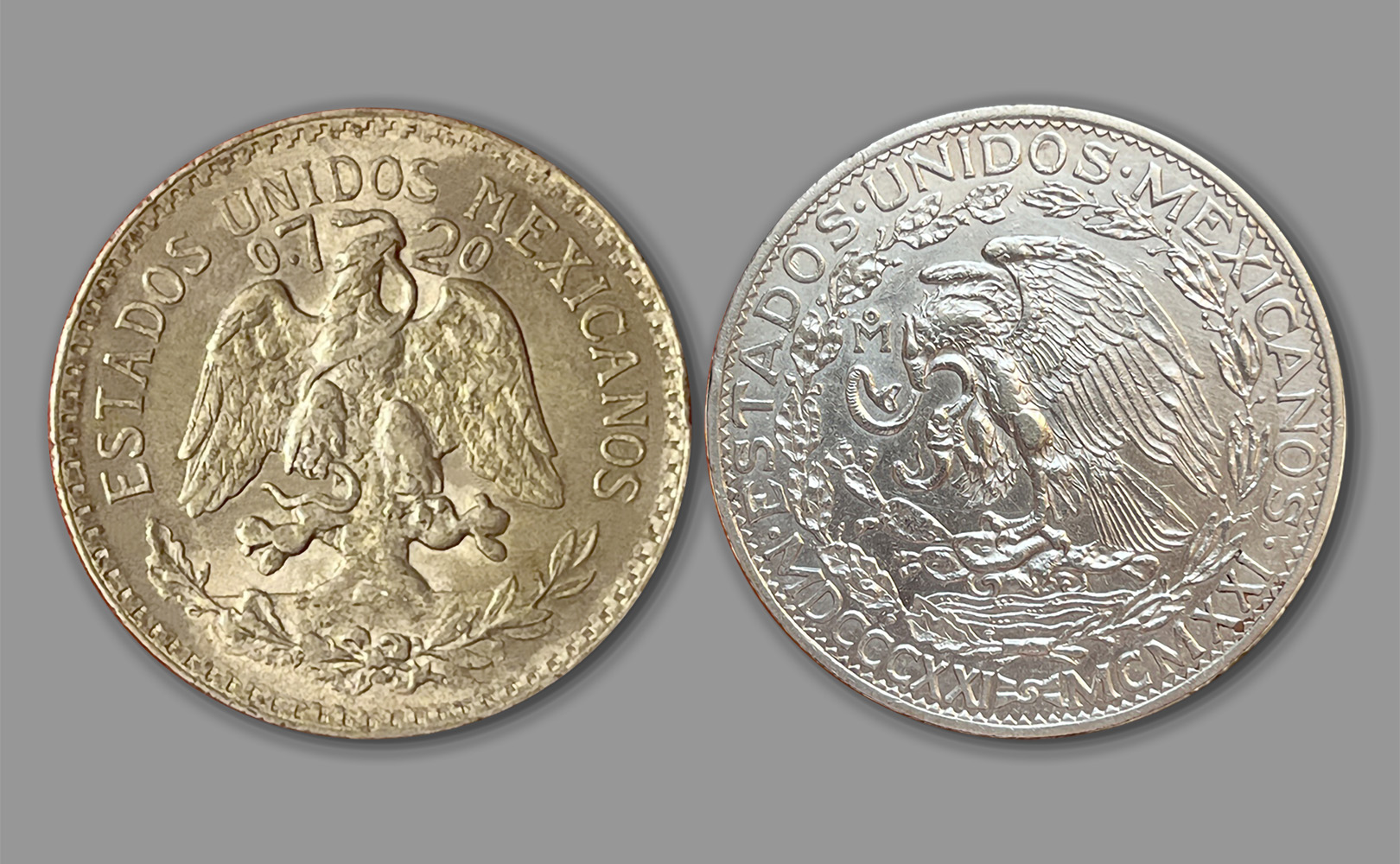
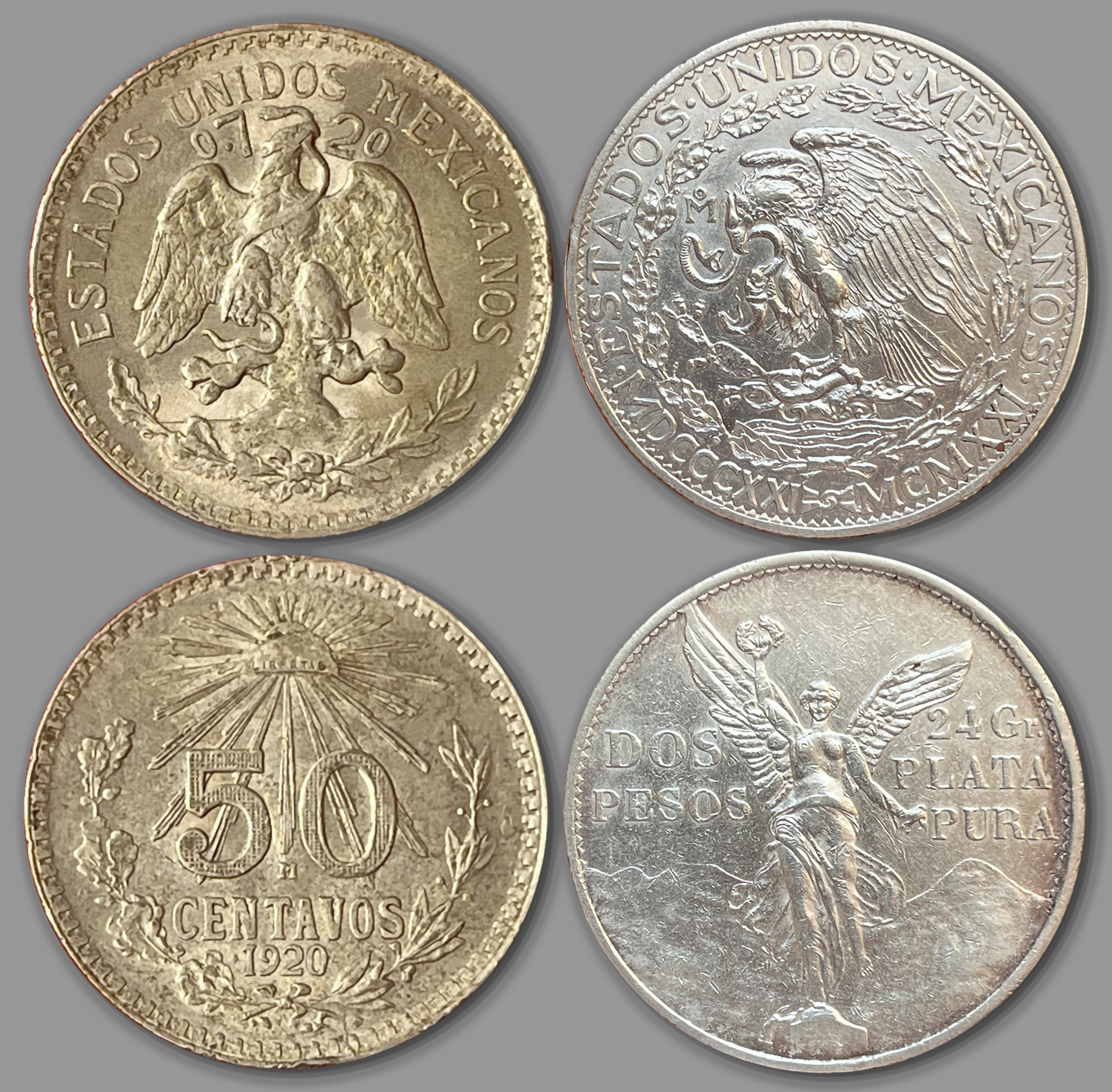 When Obregón was elected to serve as the President of Mexico in 1920, one of his first acts was to honor those who fought for México by changing the national bird on the coins. Click on the photo of the coins shown here to see the image full size.
Originally, the bird on Mexican coins faced to the right of the viewer. Obregón changed the bird to face the viewers’ left starting with the 1920 designs, a change that remains to this day. Astute viewers will also notice the more violent transformation of the bird’s wings, the gaping mouth, and the striking snake. While the coin shown were different sizes they appear to be the same size in the photo for illustration purposes. The 1920 Dos Peso coin was made of pure silver weighing 24 grams. Note that on the obverse of the 1920 silver coin the statue also lean to the viewers left. The gold color of Mexican coins comes from mixing three ingredients to make what is referred to as Aluminium Bronze. The gold color occurs from a mix of 92% copper, 6% aluminium, and 2% nickel.
 During the battles with Pancho Villa and Emiliano Zapata, Obregón had his right arm blown off in 1915. The blast nearly killed him, and he attempted to put himself out of his misery and fired his pistol to accomplish that. The aide de camp who had cleaned his gun had neglected to put bullets in the weapon. The arm was subsequently embalmed and then displayed in the monument to Obregón at the Parque de la Bombilla, on the site of where he was assassinated in 1928. Obregón always wore clothing tailored to show that he had lost his arm in battle, a visible sign of his sacrifice to Mexico. The loss of his right arm earned him the nickname of El Manco de Celaya (“the one-armed man of Celaya”).


Author: G. William Hood
Author, Columnist, Educator, Epistemologist, and Publisher