People continue to believe in New Year traditions because they provide a tangible way to mark the passage of time, foster hope for a fresh start, and offer an opportunity for reflection on the past year’s achievements and failures. These rituals allow individuals to express optimism for the future, set goals for personal development, and connect with cultural or social customs that bring a sense of community and purpose.
Psychological and Emotional Reasons
Hope and Fresh Starts: The New Year signifies a clean slate, offering a symbolic opportunity to leave the past behind and embark on a new path with renewed energy and purpose.
Reflection and Closure: Traditions provide a structured way to look back on the previous year, acknowledge both successes and difficulties, and gain a sense of closure and acceptance before moving forward.
Personal Growth and Resolutions: The new year is a time to set goals, make resolutions, and work towards self-improvement, giving people a sense of direction and motivation for personal development.
Cultural and Social Reasons
Community and Connection: Celebrating traditions together creates a sense of shared experience, unity, and connection with others who are also participating in the same cultural or social rituals.
Honoring Life and Time: Annual traditions serve as a way to celebrate and honor the cycle of life and the passage of time, acknowledging its significance in our lives.
Cultural and Religious Significance: Many traditions are rooted in deep cultural and religious beliefs, offering spiritual renewal, reinforcing values, and connecting individuals to their heritage.
Tangible and Symbolic Meaning
Concrete Rituals: Traditions offer concrete actions, like making specific foods or participating in events, which make the abstract concepts of change and new beginnings more tangible and meaningful.
Symbolic Actions: Rituals such as toasting with champagne, tequila, or pulque, and eating symbolic foods, are symbolic ways to say goodbye to the old year and welcome the new, imbuing the celebration with deeper meaning.
Mexican New Year Traditions
As the New Year is fast approaching, let’s take some time out to discuss New Year’s Traditions Celebrated in Mexico. Up front, there are no known traditions, other than food, celebrated on New Year’s Eve or day in Mexico that are unique to the country.
La Noche Vieja, although literally translated as The Night of the Old Year, is used in this sense as New Year’s Eve, and is a lively celebration in Mexico where families and friends gather to say goodbye to the old year. The festivities include eating, drinking, dancing, and participating in traditional customs for good luck.
Fireworks and parties are a significant part of the celebration, with cities hosting public events and people gathering in the streets to enjoy the festivities. Celebrating New Year’s Eve in Mexico promises a unique and exciting experience.
New Year’s Eve Food
An essential part of La Noche Vieja is the New Year’s Eve food! The night before New Year’s in Mexico, on 31st December, it’s traditional to have a big dinner. The family will gather together to enjoy a big meal.
Traditional dishes like tamales, bacalao (salted cod), and pozole (a hearty soup) are often served as part of the New Year festivities, as is the custom of having a spoonful of cooked lentils to invite good fortune in the coming year.
Tamales originated in ancient Mesoamerica, specifically in what is now Mexico and Central America, with the earliest evidence dating back to 8000 BC. Indigenous cultures like the Maya developed tamales as a portable, nutritious food source, with the term “tamale” coming from the Nahuatl word. The practice and recipes spread across various indigenous groups and evolved, with the Spanish later introducing new ingredients and cooking methods.
Among the must-have dishes, the most important is Bacalao, a dried salted codfish cooked with tomatoes and olives. The dish originally comes from Spain.
Pozole (pronunciation: [po’sole]) was invented in pre-colonial Mesoamerica, with ancient Mayan civilization having a particularly significant role in its development. This traditional Mexican dish originated from a Nahuatl word, “pozolli,” meaning “foam,” referring to the hominy corn that bursts open when cooked. While it was once served as a ritualistic meal involving human flesh for sacrifices to gods like Xipe Tótec, it was later adapted by the Spanish to include pork or chicken, and today it is a popular, symbolic dish for celebrations like Mexican Independence Day.
Pozole held deep religious significance for the Mayan civilization of Mesoamerica. Early versions of pozole were made with the flesh of human sacrifices, a practice that changed with the arrival of the Spanish. Human flesh was substituted with pork, chicken, or turkey meat after the Spanish conquest.
New Year’s Eve Traditions
Some Mexican New Year customs include grapes (Uvas), colored underwear (ropa interior de colores), suitcases (maletas), sweeping (barrido), dolls (muñecos), and lentils (lentejas). Let’s discuss eight of the most popular traditions celebrated in Mexico on New Year’s Eve.
1. Uvas for Good Luck & Wishes
At the stroke of midnight, many individuals follow the tradition of eating twelve grapes, making a wish for each grape and each second of the 12-second countdown. The tradition of eating twelve grapes on New Year’s Eve originated in Spain and is celebrated in Latin American and Caribbean countries, as well as Hispanic communities in the United States, the Philippines, and even by some Jamaican locals. Each grape represents a month of the year, and finishing all 12 by the final midnight chime is believed to bring good luck and prosperity for the new year.
The tradition originated in Spain, where it is known as Las Doce Uvas de la Suerte (“The Twelve Grapes of Luck”), and is deeply rooted in Spanish culture. Spanish celebrants gather in central squares or iconic locations with large clocks to eat the grapes in time with the twelve midnight chimes.
The tradition spread throughout Latin America and the Caribbean due to historical ties with Spain. The custom has also been adopted in the Philippines and Jamaica, which are also former Spanish colonies. And today, this tradition is practiced in Hispanic communities in other countries, including the United States.
2. Wearing Colored Underwear
In many countries, including Mexico, some individuals wear specific-colored underwear on New Year’s Eve, for the following reasons:
- To attract specific outcomes, people choose an underwear color based on what they hope to achieve in the coming year.
- To set intentions as a fun, low-effort way to set positive intentions for the new year.
- The tradition is rooted in the symbolic meanings of colors, which are believed to carry different energies.
While the wearing of colorful underwear is a global tradition, it is particularly common in Spain, Italy, Brazil, Mexico, Venezuela, and it is noticeable that the meaning of the colors does not shift extensively.
- Black: For regaining control and protection from negativity
- Blue: For good health, wellness, and peace of mind.
- Green is for financial prosperity and growth
- Pink for new or platonic love, and to strengthen relationships
- Red is for love, romance, passion, and vitality
- White is for a fresh start, purity, peace, and harmony
- Yellow, like green, is for attracting fortune and wealth
3. Throwing Coins
Tossing 12 coins outside and sweeping them into your house is a ritual for attracting prosperity. The practice of sweeping coins into the house on New Year’s is a tradition in Mexico to bring good fortune and prosperity in the coming year. It is believed that throwing twelve coins (one for each month) out the door and then sweeping them back in symbolizes sweeping out the old year and bringing in wealth for each month of the new year.
4. Burning of Año Viejo Dolls
The burning of “Año Viejo Muñecos” is a common tradition in many Latin American countries, particularly in Colombia, Ecuador, Mexico, and Panama. People create effigies or dolls, often life-sized and made from rags, straw, and sawdust, to represent the old year. These dolls can also resemble disliked politicians, celebrities, basically anything that symbolizes the negative aspects of the past year.
These “Año Viejo” dolls are set afire at midnight on New Year’s Eve, acting as a cathartic ritual to burn away the past year’s troubles and to bid farewell to past misfortunes and welcome a fresh start.
Outside of the larger cities, individuals will create life-size scarecrow-like figures, stuffing them with old clothes and newspapers, which will be burned at midnight on New Year’s Eve. Essentially, it’s a symbolic act of “burning the old year” to usher in the new one.
5. Sweeping Out Bad Vibes
Latin American countries that traditionally sweep or toss things out their doors at New Year’s to remove negative energy from the home include Cuba, Puerto Rico, Ecuador, Mexico, Costa Rica, and Uruguay. Outside of Latin America, the sweeping is also practiced in the Philippines, Ireland, and Italy.
People sweep their homes, moving towards the exit, to get rid of negative energy and bad vibes from the past year. Residents then leave their doors and windows open at midnight to invite good luck into the New Year.
6. Throwing Water Out the Window
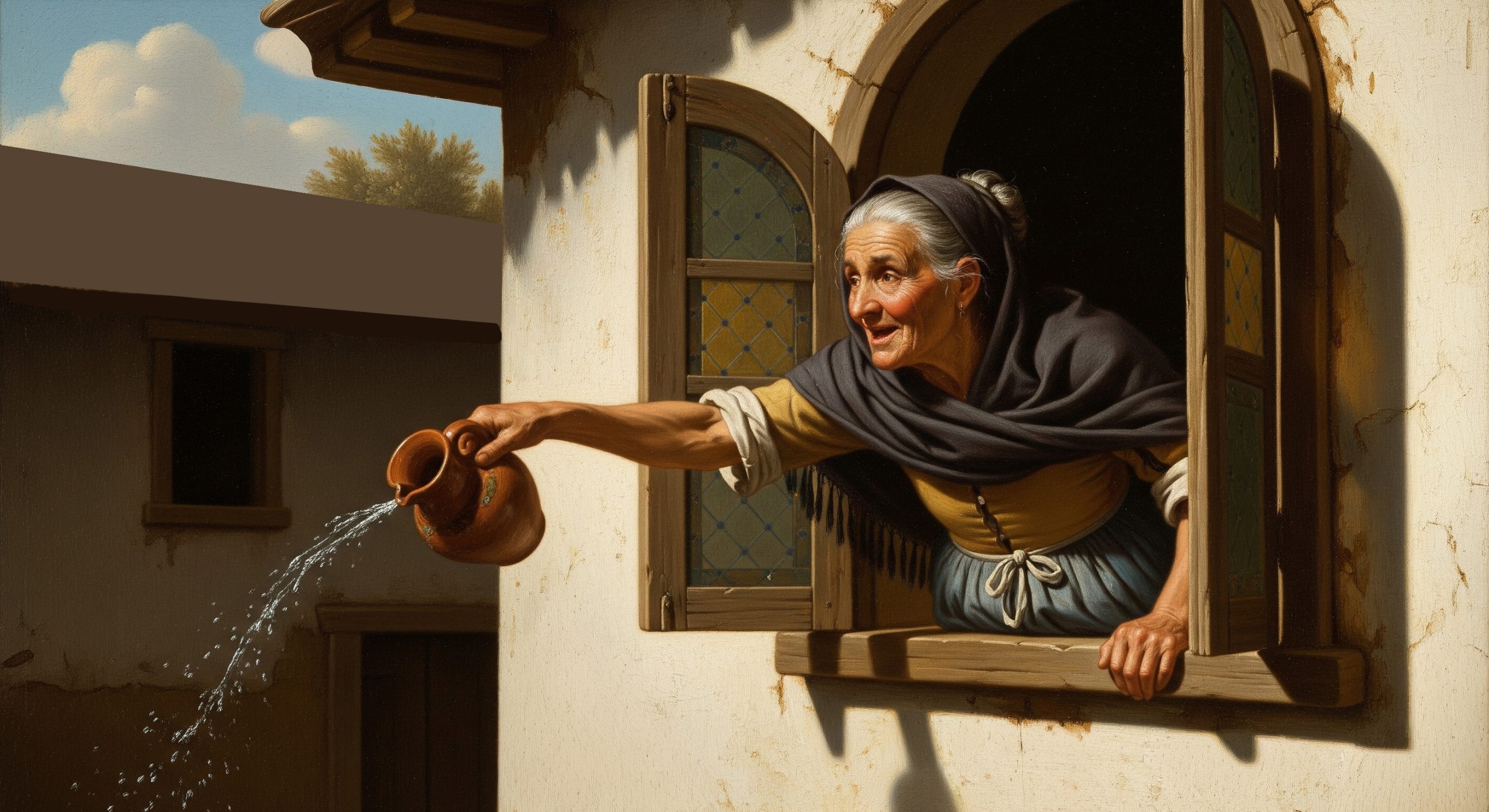
Throwing a bucket of water out the window or splashing material objects is thought to wash away bad luck, bringing renewal and attracting new experiences.
This tradition exists in Mexico, Cuba, Puerto Rico, and Uruguay. In these countries, it is common to throw a bucket of water out the window or door at midnight on New Year’s Eve. This action is believed to provide an additional cleansing of evil spirits and bad luck from the past year, making way for positive energy and good fortune.
7. Luggage for Travel
To ensure a year of travel, people take their empty suitcases for a walk around the block or gather them in the center of a room and walk around them. This is practiced in most Latin American countries, including Mexico.
Taking the empty suitcase for a walk around the block on New Year’s Eve symbolizes a playful way to attract a year filled with travel, adventures, new experiences, and good luck in the coming year. Some individuals believe that running as fast as possible around the block will bring more luck.
8. Throwing Lentils
The tradition of throwing lentils began in Spain, as the small, coin-shaped legumes are believed to bring financial prosperity and abundance in the coming year. The tradition often involves a hearty stew of lentils, sometimes with chorizo, which people consume to ensure they have money and will not go hungry. Lentils are thrown around the house or given away to bring wealth and abundance. Lentils are eaten or used in rituals for good luck and prosperity on New Year’s Eve or Day.
Today, the tradition has spread to Mexico, Chile, Colombia, Italy, and other countries. In these countries, lentils symbolize coins and abundance, and people might eat them, carry them in their pockets, or leave them by their doors to welcome wealth into the new year.
New Year’s Day Celebrations
In Mexico, New Year’s Day, which is a national public holiday, is celebrated with family gatherings to enjoy a feast of traditional dishes. Leftovers (el recalentado) may be enjoyed as well. There will be stories to tell about the night before, as well as the setting of goals and resolutions for the future.
Feliz Año Nuevo!


Author: G. William Hood
Author, Columnist, Educator, Epistemologist, and Publisher