Ernest Jere Busenbark (11 September 1887 – 15 November 1982), an artist, author, illustrator, graphic designer, educator, and a published author.
Busenbark was born in Crawfordsville, Indiana to James Henry Busenbark (26 March 1852 – 23 July 1934) and Martha E. Martha E. Strange (1858 – 1939) His brother was Claud Eldridge Busenbark (23 June 1884 – 12 December 1957). Busenbark is a descendant of Johann Bossenberger (b. 1612) in Bockendorf, Hessen-Nassau, Prussia. The family name was changed to Busenberger in 1698, and then to Busenbark in 1767.
In 1918, he received his Army Enlistment Card WWI, serving his two years in the USA. Upon leaving the military Busenbark settled in New York City. An article from the St. Petersburg Times stated that he had studied with Arthur William Best, a prominent landscape artist. He also studied at the Chicago Art Institute, the Artist Student League and the Cooper Union Institute in New York City. He joined the newly founded Guild of Free Lance Artists and would become an officer within the guild. His first known exhibit was at the Art Institute of Chicago’s Third Annual International Watercolor Exhibition in 1923, with his painting “Bringing in the Lobster Pots.”
He married his wife Eleanor Finlay (b. 1892-deceased), on 22 October 2017 and they setup a home in the Rose Hill Neighborhood of Manhattan at 117 East 27th Street in New York City.
During the 1930s and 40s, Busenbark worked for the Works Progress Administration (WPA). The Federal Arts Project was created under the WPA and the Archives of American Art and the U.S. The General Services Administration still keeps records and shows that Busenbark was an active employee. Under this program artists accomplished artworks and worked to document American decorative objects from colonial times to 1900 in watercolor and colored pencil. The decorative collection was known as the Index of American Design, and Busenbark did numerous illustrations that are now housed in the National Gallery of Art collection in Washington, DC. He went on to serve as the head of WPA’s Poster Division. Many of these posters were used in pre-WWII America to communicate concerns with the public. Busenbark did illustrations for the “Index of American Design” WPA work, now located at the National Gallery of Art, Washington, DC. While at the WPA, he worked with Anthony Velonis, Harry Gottlieb, Beatrice (Bea) Mandelman, and Max Arthur Cohn. It was while working at the WPA that Busenbark was introduced to screenprinting or silk screen printing as it was called at the time.
In 1938, Busenbark teamed with Jacob (Jack) Israel Biegeleisen to author the book “The Silk Screen Printing Process.”
Busenbark held an interest in popular customs, myths, superstitions an religious beliefs. He was a scientist and an epistemologist, with an unquenchable thirst for knowledge. Early in his career, he began to maintain notes about these interests and in 1949, he published “Symbols, Sex and the Stars,” in which he discussed the origins of moon and sun worship, astrology, the meaning of numbers, the cabala and much more. In the forward to the book Busenbark wrote:
“The world is finally coming of age. There is a large and rapidly increasing number of persons who, like the author, are unable to accept a belief or a set of beliefs merely be cause they are very old and widely accepted. Rather than adopt a ready-made philosophy of life based upon beliefs which have come down from the Stone Age, they prefer to weigh the evidence, do their own thinking and draw their own conclusions. This is particularly true in regard to beliefs which cannot be proved by daily experience, such as those based upon the miraculous or the supernatural.“
After his WPA period he maintained a studio and continued to work in New York City. In 1955, he left NYC and moved to Clearwater, Florida becoming a noted Florida artist. In 1956, Busenbark became an instructor at the Florida Gulf Coast Art Center and in 1964 began teaching silkscreen printing.
Most of his paintings are signed in simple block letters: E. Busenbark, or on occasion, E. J. Busenbark. His paintings fit into two categories; American Impressionism and Realism, he once wrote an art manifesto where he spoke out against American Abstraction.
Upon his arrival in Florida, he jumped right into the Florida art scene, and quickly became the President of the Clearwater Art Group and was hired as an instructor at the Florida Gulf Coast Art Center. A newspaper announced that Busenbark would teach a silk screen class, not surprising as he had co-authored a book: The Silk Printing Process, published by McGraw-Hill. At the Art Center he worked with numerous noted Florida artists, such as: William Pachner and Syd Solomon.
Busenbark received a mention in 1957 in the Tampa American Art Week, and the Tampa Municipal Museum provided an exhibition of his work. This one-man exhibit showcased his first Florida paintings and watercolors. As in the painting below: The Old Florida Oak (with Resurrection Fern), Busenbark painted the scene on Masonite. Masonite was invented 1924, where wood fibers were pressed into thin dense hard sheets. A sheet had two sides, one that was smooth and the other felt side is textured, due to the manufacturing process. Masonite was not meant for paintings, however artists found the product resilient and discovered it would not warp.

corner: E. Busenbark
In this pastoral scene, Busenbark used the felt side of the Masonite, adding to his American Impressionist style. He incorporated the textured surface to make his brushwork look rapid and broken with separate dabs to render impressionism. Clearly, Busenbark was influenced by some of the great American landscape artists of the 1920s, and in this case his teacher: Arthur William Best.
On April 28, 1960, Busenbark’s article, “Problems Confronting the Artist“, was published in the Tampa Bay Times. In Busenbark wrote an opinion article for the Tampa Bay Times, expressing his outrage of abstraction vs. realism, and his concerns about the radical side of new art expression.
Busenbark, used his artistic skills to create light and shadow in this painting, the sun-drenched yellow-chartreuse field provides luminosity to the composition and then he used shades of forest green for shadows. The tree limbs frame the farmhouse buildings in the distance and the red-brown barn serves as the central focus anchoring the painting. The old Florida oak is reflected in the stream, while the sun highlights the tree branches and the hanging resurrection ferns. This is an impressive example of Florida sublime, as these country scenes are diminishing with the state’s expedient growth.
Busenbark lived a long life and died Pinellas, Florida in 1982 at the age 95.
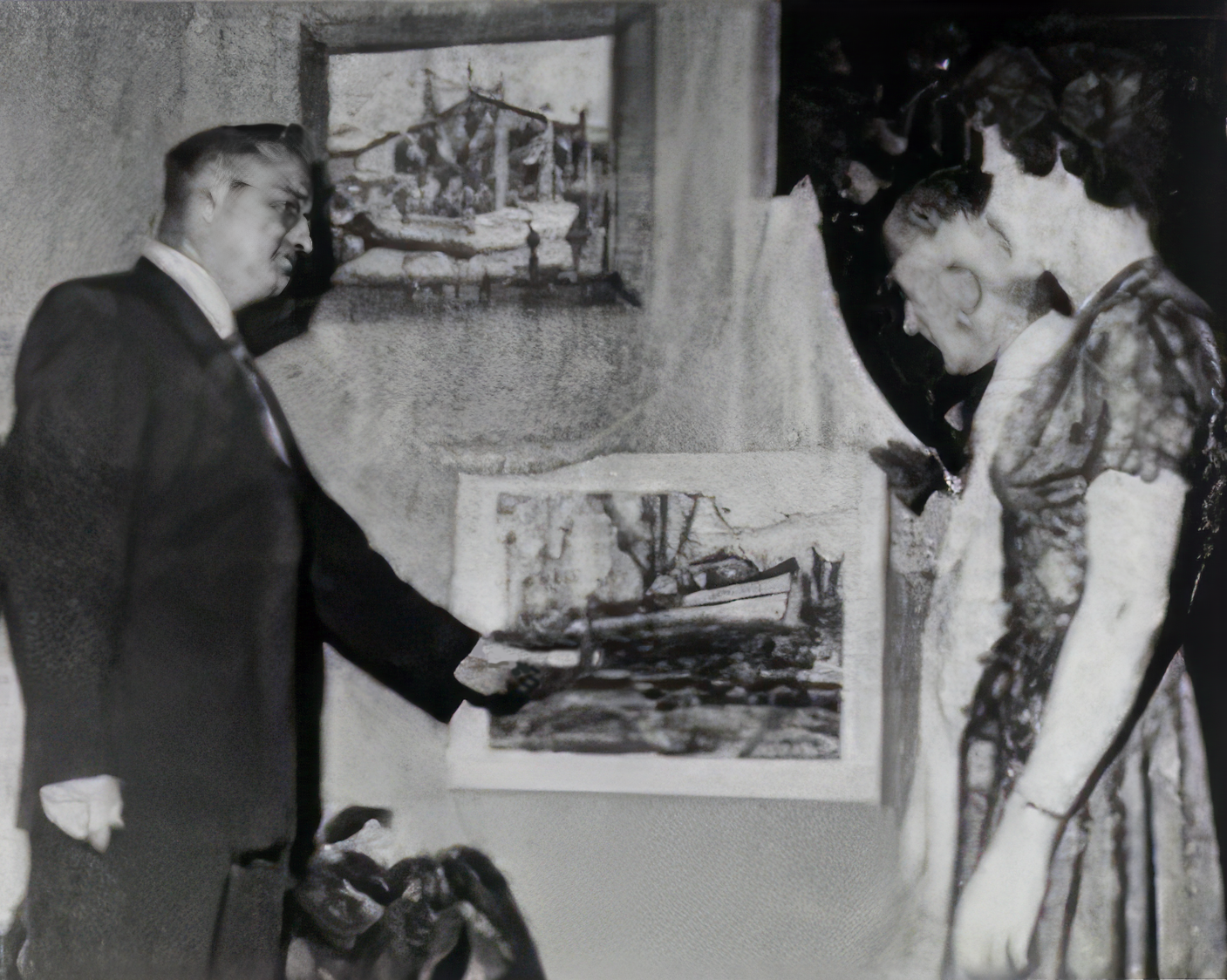
In this photo, Dr. Charles S. Giles (far left), Professor of Fine and Industrial Arts, and his wife
(far right) discuss a painting with Ernest Busenbark (right of Mrs. Giles) at the 1959 Tampa
Florida Arts Festival. Busenbark was 72 years old at the time.
Exhibitions
1957 – Florida One-Man Show, Tampa Municipal Museum – American Art Week, Tampa, Florida.
1958 – Watercolor Exhibit (Marine Scenes), Clearwater Library, Tampa Bay Florida.
1969 – Exhibition, Tampa Realistic Artists, Inc., Tampa Bay Times, April 27th.